
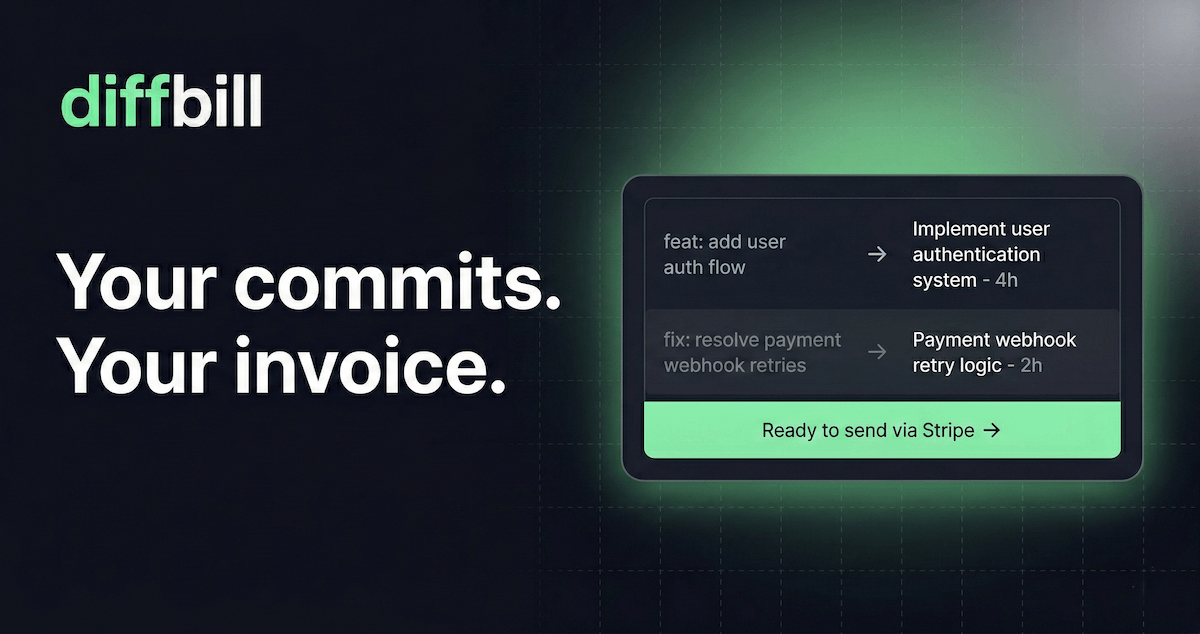
Introducing diffbill: turn GitHub work into invoices your clients approve faster
Today we are launching diffbill, built for freelancers and consultants who are tired of losing billable work between merged pull requests and monthly invoices.
If you bill clients for software work, you already know the weird part. Shipping work is hard, but invoicing it clearly is often harder.
You finish the month with a long list of commits and pull requests. Then you sit down to write invoices and try to remember what actually happened. A quick auth fix. A refactor that made deployments stable again. A handful of small bug fixes that each took ten minutes, but together took hours.
By the time the invoice goes out, a lot of important work is missing or written so vaguely that clients ask for clarification.
That is exactly why we built diffbill.
Human memory is a poor billing system. Your shipped work deserves a better record.
The old billing workflow is full of hidden leaks
Traditional invoicing breaks in predictable ways for developers and technical consultants.
- You forget work that was real but not memorable.
- You under-describe work because you are writing from memory.
- You spend too much time translating technical work into client language.
- You lose confidence in your own invoice because it feels incomplete.
Most people try to fix this with better discipline. Better notes. Better weekly docs. Better naming conventions.
Those habits help, but they still rely on manual recall. Human memory is not a billing system.
Why this problem is more expensive than it looks
The obvious cost is lost time.
The bigger cost is lost revenue and avoidable friction.
When line items are unclear, clients hesitate. When invoices look thin, you second-guess what to include. When context is missing, you either underbill or start long email threads to justify work that should have been obvious from the start.
Over a year, that adds up to a meaningful amount of money and mental overhead.
We have talked to freelancers who can ship production code all week with confidence, then feel anxious when they open their invoicing tool.
That confidence gap should not exist.
What diffbill does
diffbill connects to your GitHub repositories, pulls merged pull requests, and uses linked issues as context.
From there, it helps you generate invoice-ready line items that are clear, professional, and tied to real work.
You can:
- review and edit generated line items
- exclude work that should not be billed
- keep source-linked evidence attached
- export clean billing language into your invoicing flow
The goal is simple: less reconstruction, more confidence.
You should never need to choose between billing accurately and finishing your invoice in a reasonable amount of time.
Key Takeaways
- Traditional invoicing leaks revenue through forgotten and under-described work.
- diffbill starts from merged pull requests and issue context, then drafts client-ready line items.
- You can review, edit, exclude, and keep source evidence before sending.
How the AI actually works
The AI layer in diffbill does one specific thing: it reads your pull request titles and linked issue descriptions, then rewrites them in language your clients understand.
It does not invent work. It does not pad descriptions. Every output is grounded in a real, merged pull request — the AI's only job is translation.
A few details worth knowing:
Tone control. Before generating, you choose a tone: Formal keeps language precise and conservative. Neutral is clear and professional. Casual is conversational and natural. Different clients have different expectations, and you should be able to match them without rewriting everything yourself.
Verbosity control. Choose between short one-line summaries or full paragraph descriptions. Short works well for simple bug fixes. Full works well for feature work that needs more context.
Redaction. Some PRs touch internal architecture or security changes that should never appear in a client invoice. You can flag those details for redaction before the draft goes anywhere.
Flexible date ranges. Bill by sprint, by calendar month, or by any custom range. diffbill pulls the merged PRs that fall within your window and nothing else.
Connect your GitHub repository
Authorize via GitHub OAuth. diffbill pulls merged pull requests and linked issues for your billing window — public and private repos both work.
Generate your draft
Choose your date range, set your tone, and let diffbill draft invoice-ready line items grounded in your real shipped work.
Review and refine
Edit any line item, exclude non-billable work, adjust verbosity, and redact anything sensitive. You stay in full control.
Send with confidence
Export clean billing language into your invoicing flow with source evidence attached. Fewer clarification threads, faster approvals.
A product decision we cared about from day one
We did not want to build another generic AI writing layer.
The product is grounded in evidence first. Pull requests and issues are the source of truth. The writing layer exists to make that truth readable for clients, not to invent work or inflate value.
That distinction matters.
People trust invoices when they feel specific and verifiable.
Who diffbill is for right now
diffbill is built for people who ship client work directly from GitHub:
- freelancers
- independent consultants
- small dev shops
- technical founders doing services work
If your monthly billing process still depends on memory and scattered notes, this is for you.
If your team already has a perfect internal time-tracking and invoicing workflow with no friction, you probably do not need diffbill.
What happens next
This launch is the beginning, not the finish line.
We are focused on three things in the near term:
- making line-item quality even more consistent
- expanding controls for billing tone and redaction
- improving integrations around the final invoice handoff
We will keep shipping in the open and listening closely to users who bill this way every week.
If that is you, we would love your feedback.
Common questions
Create your account and generate your first invoice-ready draft