

5 Best Stripe Alternatives for Developer Billing in 2025
Explore the best Stripe alternatives for freelance developers and SaaS founders. Compare transaction fees, MoR capabilities, and API developer experiences.
Compare the top Stripe alternatives like Paddle, Lago, and Braintree. Discover whether you need a new payment processor or just a better workflow for your technical invoicing.
What Are the Best Stripe Alternatives for Developer Billing?
If you are searching for the best stripe alternatives for developer billing, the right choice depends entirely on your business model. Whether you need a full Merchant of Record, a highly customizable open-source billing engine, or a mature payment gateway, moving away from Stripe requires matching your new processor to how you actually charge clients.
Key Takeaways
- Paddle: Best for handling global taxes and compliance.
- Lago: Best open-source option for custom and usage-based models.
- Braintree: Best alternative gateway with mature documentation.
Comparing the top payment processors
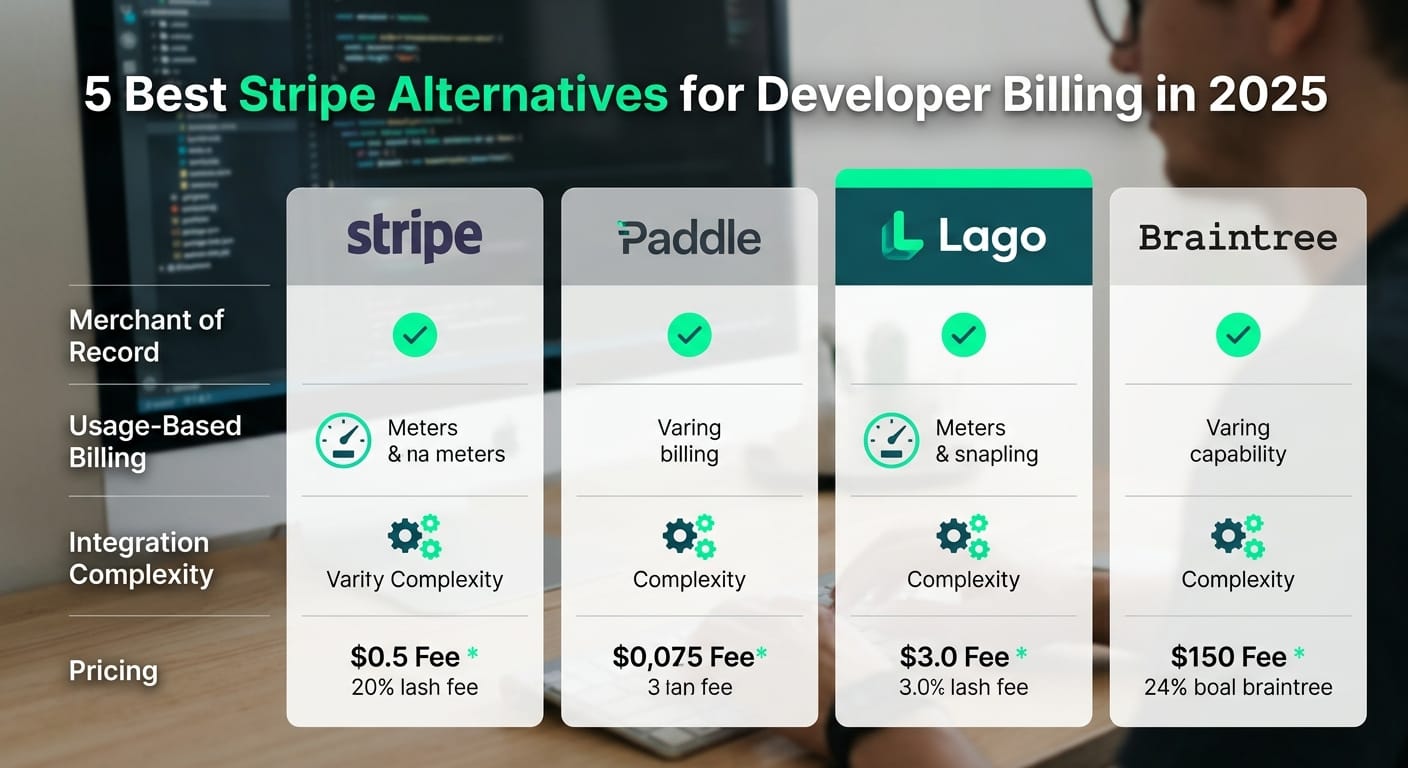
Paddle stands out as a full Merchant of Record (MoR) rather than just a simple payment gateway. When you sell SaaS or digital products globally, Paddle takes on the tax compliance and liability for you, according to Source 1. This means you can focus entirely on shipping your application rather than calculating complex regional sales taxes or managing global fraud risk.
If your product relies on complex parameters, Lago is the top open-source Stripe alternative. According to Source 3, it allows you to set up progressive billing, postpaid models, or prepaid credit systems without locking you into a confusing platform pricing grid. Because Lago is infrastructure-agnostic, you can connect its billing logic directly to your existing payment service providers and database architecture.
For teams that need a reliable, alternative gateway, Braintree offers a highly mature set of developer APIs. It is heavily embedded in the PayPal ecosystem, making it a natural fit if your user base prefers checking out with PayPal wallets. As noted in Source 4, while the dashboard might lack some modern polish, the backend rails are proven and dependable for scaling SaaS platforms.
Why Freelance Developers Start Looking for a Stripe Alternative
Freelance engineers almost always default to Stripe, but its growth into a massive suite of 21 products has created notable friction. When searching for the best Stripe alternatives for developer billing, most technical consultants are trying to escape pricing complexity, sudden account holds, and administrative drudgery.
Three Reasons Developers Look for an Alternative
Stripe Billing is standard for a reason, offering excellent APIs and global reach. However, as the platform has expanded, it has introduced distinct pain points for independent developers trying to scale their client work. According to Source 3, the platform now relies on an incomprehensible pricing grid that makes it difficult to forecast exact processing costs.
When comparing developer invoicing software, freelancers typically point to three recurring bottlenecks:
- Sudden account holds: Nothing kills freelance cash flow faster than a frozen payment. Many businesses explore a Stripe Connect alternative because the platform frequently issues unannounced account shutdowns with steep learning curves and minimal support to resolve them (Source 2, Source 4).
- Confusing fee structures: Stripe operates with stacked pricing models that quickly eat into consulting margins. Developers pay base transaction fees, plus additional percentages just to access the recurring invoice and subscription features inside Stripe Billing (Source 1).
- Manual invoicing workflow: Actually drafting an invoice inside the default Stripe dashboard is an incredibly tedious, manual process. You still have to spend hours translating your shipped code and merged GitHub pull requests into professional, client-ready line items.
Evaluating Stripe alternatives for developer billing means looking honestly at your current tech stack. If you are tired of paying high transaction margins or dealing with frozen funds, switching your payment gateway is the right move. However, if your main frustration is the manual hours spent translating technical work for client invoices at the end of every month, a new payment processor will not fix your broken workflow.
Top 3 Alternatives to Stripe: Paddle vs Lago vs Braintree
When evaluating the best stripe alternatives for developer billing, your choice depends entirely on your compliance needs and pricing models. Instead of a one-size-fits-all approach, you can choose specialized infrastructure:
- Paddle takes over global tax compliance as a Merchant of Record.
- Lago provides open-source, usage-based metering.
- Braintree offers developer-friendly APIs backed by PayPal.
Paddle: The Merchant of Record approach
Unlike a standard payment gateway, Paddle operates as a Merchant of Record. This means they assume the legal liability for processing global taxes and staying compliant on your behalf (Source 1). If you want to completely offload VAT collection and international tax logic so you can focus on building, Paddle is a highly effective Stripe alternative.
Lago: Open-source usage-based infrastructure
For teams that need total control over complex pricing tiers, Lago provides an agnostic, open-source alternative to Stripe Billing. It handles postpaid routines, prepaid credits, and progressive billing while letting you connect to any payment processor (Source 3). This makes it a standout choice among the best stripe alternatives for developer billing if your software relies heavily on granular usage events.
Braintree: Developer-first API with massive reach
Braintree delivers the same developer-first onboarding and API customization that made Stripe popular in the first place. Backed by PayPal, it connects your platform to a massive global network while keeping the integration process straightforward and flexible (Source 4). This is a strong option if your engineering team wants a proven payments backbone without getting locked into Stripe's ecosystem.
The Status Quo Alternative: Fix Your Stripe Invoicing Workflow
Ripping out your entire payment infrastructure is a massive project that you might not actually need. When evaluating the best stripe alternatives for developer billing, consider that your real bottleneck is likely the manual admin work. Most freelancers simply need a faster way to go from merged PRs to client-ready line items.
Switching to a different payment processor means rebuilding API integrations and risking disruption to your cash flow. Stripe's developer-friendly API and global reach are already top-tier, but their native dashboard wasn't built for translating technical GitHub pull requests into billable client line items. That disconnect between your codebase and your gateway is where your time drains away every month.
Automate the translation layer instead
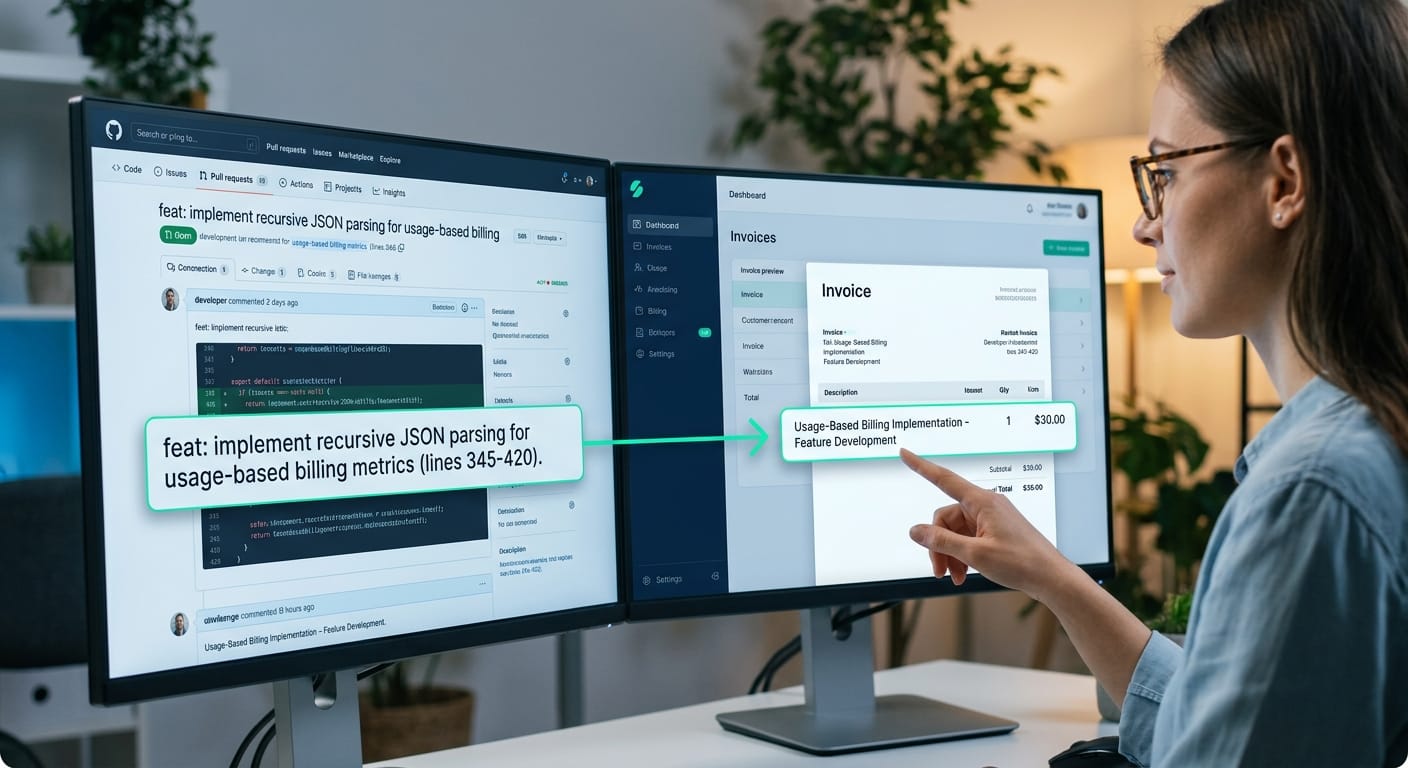
Instead of migrating payment gateways, you can fix your workflow by connecting your existing Stripe account directly to your GitHub repositories. Using an AI-powered tool like diffbill lets you maintain Stripe's reliable payment rails while completely eliminating the administrative friction of invoicing. This approach offers several distinct advantages for solo developers and consultants:
- Zero migration risk: Keep your existing Stripe setup, customer data, and subscription logic intact.
- Automated translation: Convert PRs to invoices automatically to easily translate highly technical PR descriptions into client-friendly drafts.
- Source-linked transparency: Provide clients with verifiable audit trails linking billed items directly to shipped code.
Optimizing your billing ops doesn't have to mean migrating everything from scratch. By adopting a keyboard-first workflow that automatically bridges your versions control and your payments, you create one of the best stripe alternatives for developer billing out of the infrastructure you already trust.
Start billing for free
Frequently Asked Questions About Developer Payment Gateways
When migrating your financial stack, evaluating the best stripe alternatives for developer billing comes down to three core factors: transaction fees, payout velocity, and API flexibility. Whether you run a SaaS platform or a localized marketplace, finding the right gateway means balancing familiar developer experiences against long-term unit economics.
Evaluating Platform Control and Economics
Technical teams often adopt gateways strictly for their documentation, but product and finance teams eventually require more control over the payment program. According to Source 2, comparing these infrastructure options requires looking well beyond the initial integration code. Before committing to a new payment processor, you should evaluate the platform's constraints around onboarding and global processing.
To ensure your new infrastructure can support your product roadmap, evaluate these key architecture requirements:
- Payouts and onboarding: Determine if you need robust split-payout capabilities and flexible API control over how sub-merchants onboard.
- Risk tolerance and coverage: Research the provider's global acquiring footprint, alternative payment methods, and historical risk tolerance for your specific business model.
- Billing layer flexibility: Separate the core payment processor from the recurring billing engine. If you rely on complex models like postpaid metered computing, Source 3 notes that an independent, open-source billing ecosystem often scales better than a locked-in vendor.
Navigating these distinct layers naturally brings up overlapping terminology and complex pricing structures. Here are straightforward answers to the most common questions developers have when researching new payment gateways.