
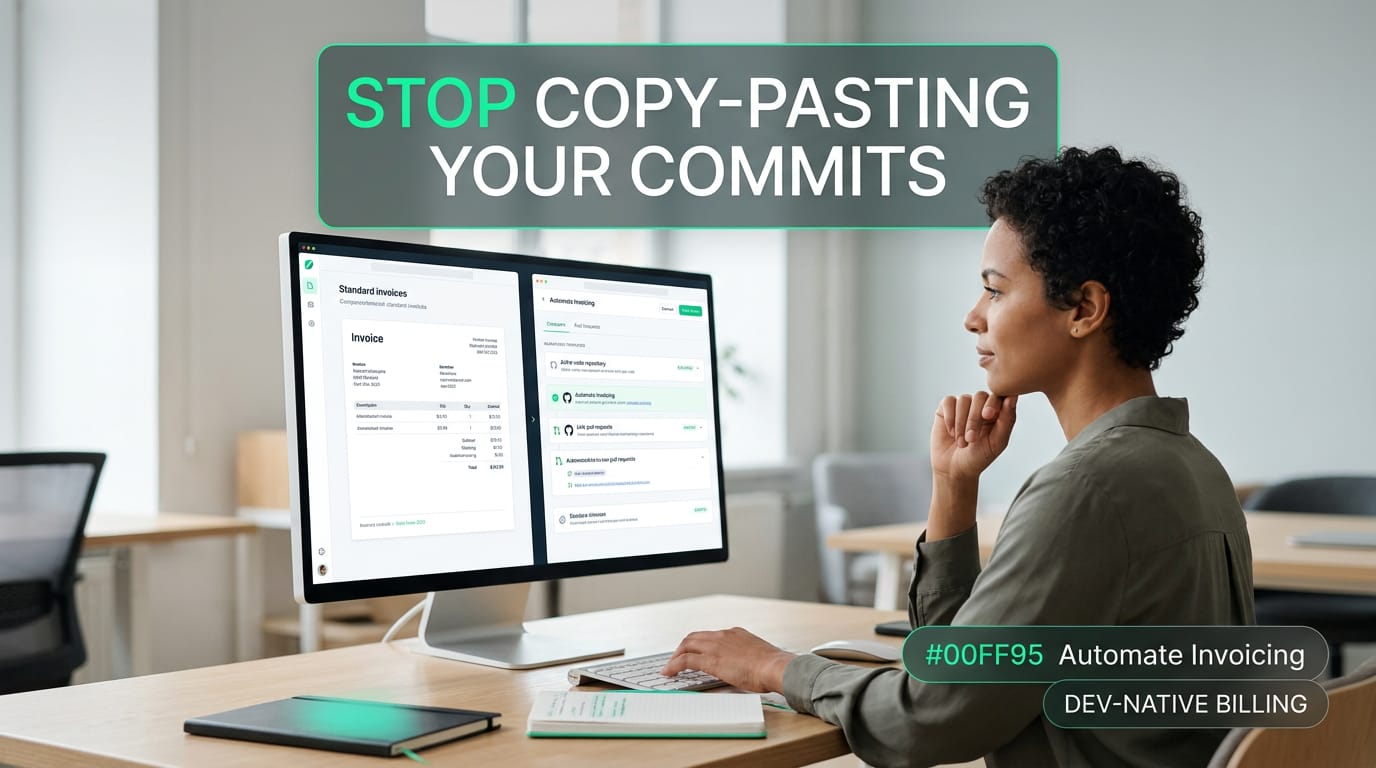
Developer Invoicing Software Comparison: Stop Copy-Pasting Your Commits
An in-depth comparison of standard invoicing software versus developer-centric automated billing tools, highlighting the features that matter most for tech consultants.
Compare common invoicing apps against developer-native billing tools to find out how automating your PR-to-invoice workflow can save you hours of admin work.
The mismatch between standard accounting tools and developer workflows
Dive into almost any developer invoicing software comparison, and you'll quickly notice that mainstream billing platforms treat software engineers like conventional contractors. Instead of hooking into your existing Git workflow, tools like Wave, Square, or even standard Stripe Invoices force you to start from a blank slate at the end of every month. They require you to manually reconstruct your output, completely ignoring the fact that your work is already meticulously tracked.
As a developer, you already write descriptive commit messages, detail your pull requests, and link everything back to an issue tracker. Traditional accounting tools discard this rich trail of evidence. By forcing you to manually re-type and translate your technical output into client-ready line items, these platforms turn billing into a tedious administrative chore.
Why generic invoicing falls short for engineers
- Context switching: You have to dig through weeks of merged Git history just to remember exactly what you shipped and when, which easily leads to underbilling on small fixes.
- Translation overhead: Non-technical clients don't want an invoice stating "Refactored JWT middleware"—they need to read "Upgraded authentication security."
- Wasted billable hours: You essentially spend an entire afternoon doing data entry when you could be writing code or enjoying your weekend.
The defining line in a true developer invoicing software comparison is whether the tool treats your repository as the primary source of truth. Developer-native billing recognizes that your commits and merged code already contain the hard data needed for an invoice, eliminating the tedious copy-paste routine entirely.
Must-have features when evaluating developer invoicing software
A modern billing stack requires deep API connections to the tools you already use, so you never have to context-switch just to get paid. When you evaluate developer invoicing software, the goal isn't just to generate a visually appealing PDF. You need an automated workflow that bridges the gap between the code you ship and the money you collect.
Key Takeaways
- Direct integrations with source control (GitHub) and payment processors (Stripe).
- Client-ready tone conversion for technical descriptions.
- Source-linked audit trails for total billing transparency.
Moving beyond manual data entry
Standard billing apps are great for graphic designers or writers, but they treat invoicing as a manual data entry task. If you use a generic tool, you often end up spending hours copying pull request titles, tracking down merged branches, and pasting them into line items. True developer invoicing software connects directly to your source control and payment gateway to automate client invoicing from GitHub activity, turning your shipped features into quantifiable billing data.
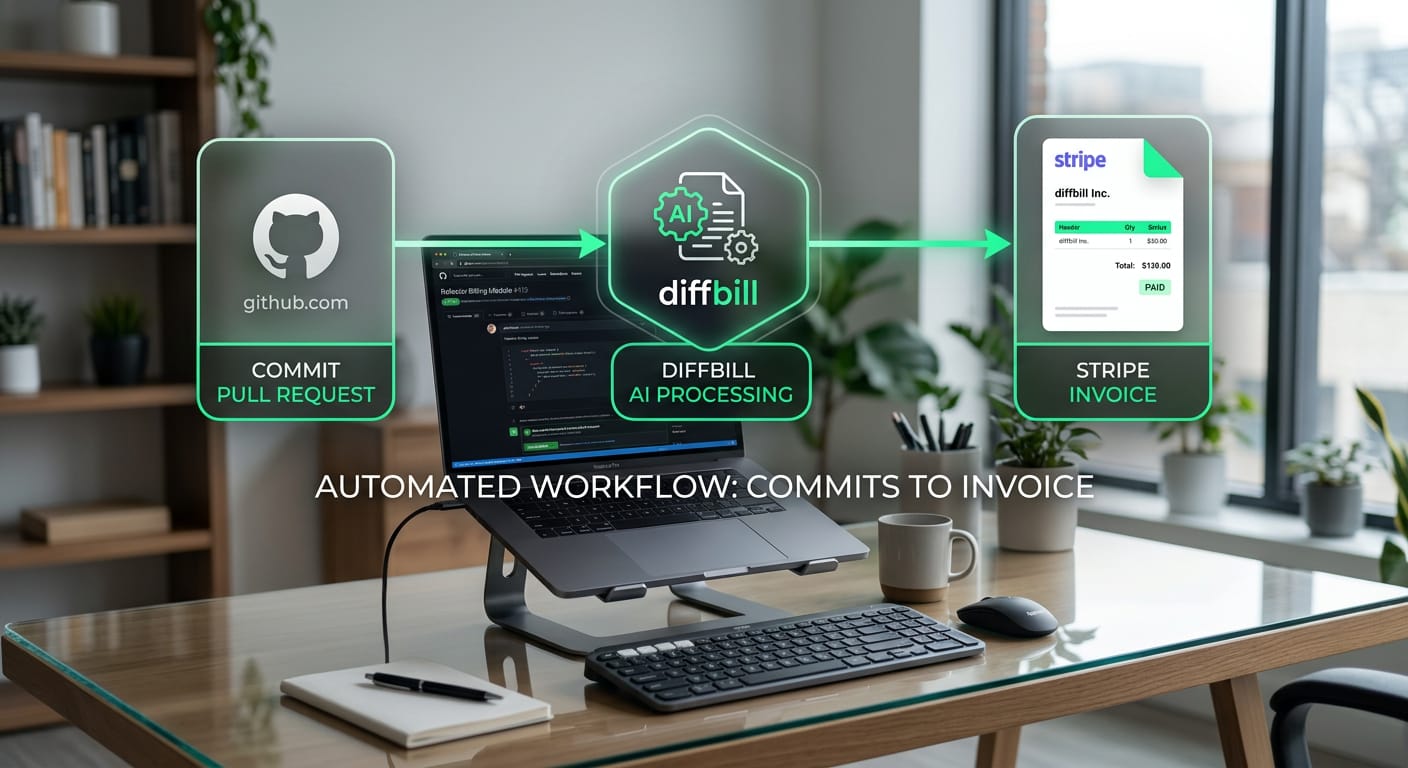
Another major tradeoff to consider is how the platform handles client communication. Your commit messages are written for other software engineers, not for the non-technical founders or project managers approving your invoices. The best billing software for freelancers uses AI to automatically rewrite complex technical jargon into professional, client-friendly descriptions. This keeps your clients happy without forcing you to mentally translate your work history at the end of every month.
Finally, billing transparency is crucial for maintaining trust and reducing payment disputes. When clients understand exactly what they are paying for, invoices get approved and paid much faster. Look for tools designed specifically for the developer workflow that include:
- Source-linked audit trails connecting every invoice item back to the original GitHub pull request.
- Customizable tone controls so you can adjust the level of technical detail based on the client's preference.
- Direct checkout features where the reviewed draft automatically becomes a payable Stripe invoice.
General freelance billing apps vs. developer-centric platforms
When you look at any standard developer invoicing software comparison, you'll quickly notice a divide between general business tools and platforms built specifically for shipping code. Apps like Wave, Harvest, or even native Stripe Invoicing are fantastic for standard freelance time-tracking and sending polished PDFs. However, they treat software engineering like any other generic hourly service. This leaves you doing the heavy lifting at the end of the month, manually translating your commits and pull requests into line items a client will actually understand.
The biggest hidden cost of general-purpose billing apps is the context switch. You spend weeks deep in the codebase fixing bugs, squashing edge cases, and refactoring architecture. Then, on billing day, you have to parse through your own Git history to reconstruct what you actually did. Summarizing complex technical implementation details into client-friendly language drains your energy and burns hours of unbillable admin time.
Where developer-native tools change the workflow
Developer-centric platforms bridge the gap between your version control and your bank account. Instead of starting from a blank invoice template, these tools plug into your existing workflow to automatically convert a PR to an invoice.
- Automated translation: By reading your repository activity, these tools rewrite technical pull request descriptions into professional, business-focused value.
- Built-in proof of work: Line items can link directly to merged PRs, giving your clients a transparent audit trail of exactly what was shipped.
- Eliminated manual entry: You completely stop copying and pasting between GitHub and your accounting dashboard, cutting your monthly billing cycle down to minutes.
The hidden cost of translating technical jargon for your clients
Every month, freelance developers lose valuable hours trying to turn complex repository updates into professional invoice line items. When you look at any standard developer invoicing software comparison, most tools focus heavily on payment gateways or generic design templates rather than the actual workflow of billing for code. They leave the hardest part—translating technical jargon into clear business value—completely up to you.
This manual translation suffers from a massive status quo bias. You probably open your Git history, read through a dozen technical pull requests, and agonize over how to rewrite "refactored auth state" into something a non-technical client will happily pay for. You tolerate this tedious admin work simply because that is how it has always been done.
The gap in traditional billing tools
Generic billing platforms are great at handling the math and tracking time, but they offer no help when it comes to writing the actual invoice. This forces you into a repetitive, multi-step routine right when you would rather be shipping features:
- Scrolling back through weeks of GitHub commit histories to remember what you actually did.
- Sanitizing raw developer jargon and redacting internal issue tracker links.
- Formatting those updates into a language that highlights clear business momentum.
Implementing effective developer invoicing automation strategies changes this dynamic entirely. Instead of starting from a blank document, purpose-built tools automatically rewrite your merged pull requests into polished, client-ready descriptions. Handing this translation layer off to AI eliminates the cognitive drain of your billing cycle, letting you stop copy-pasting and start getting paid.
Choosing the right tool to accelerate your billing cycle
The clearest takeaway from any developer invoicing software comparison is that generic billing apps expect you to do the heavy lifting. While traditional platforms help you design a decent-looking PDF, they still force you to manually type out every billable hour and project milestone. To truly accelerate your billing cycle, you need specialized software that bridges the gap between your codebase and your bank account.
Evaluating your workflow tradeoffs
Traditional platforms are great for standard freelance gigs, but they fall short for engineering work. You end up spending hours translating raw commit messages and pull requests into digestible line items for non-technical clients. Every minute spent copy-pasting code summaries is unbilled time that you could have spent shipping features.
A developer-native approach flips this script by automating the translation layer. When looking at your options, prioritize tools that offer these workflow enhancements:
- Source-linked audit trails: Automatically link billing line items to the actual merged pull requests to build client trust.
- Context-aware rewriting: Rely on smart automation to turn technical commits into professional, client-friendly descriptions.
- Keyboard-first efficiency: Navigate your drafts and edit pricing with the exact keystrokes you already use in your terminal.
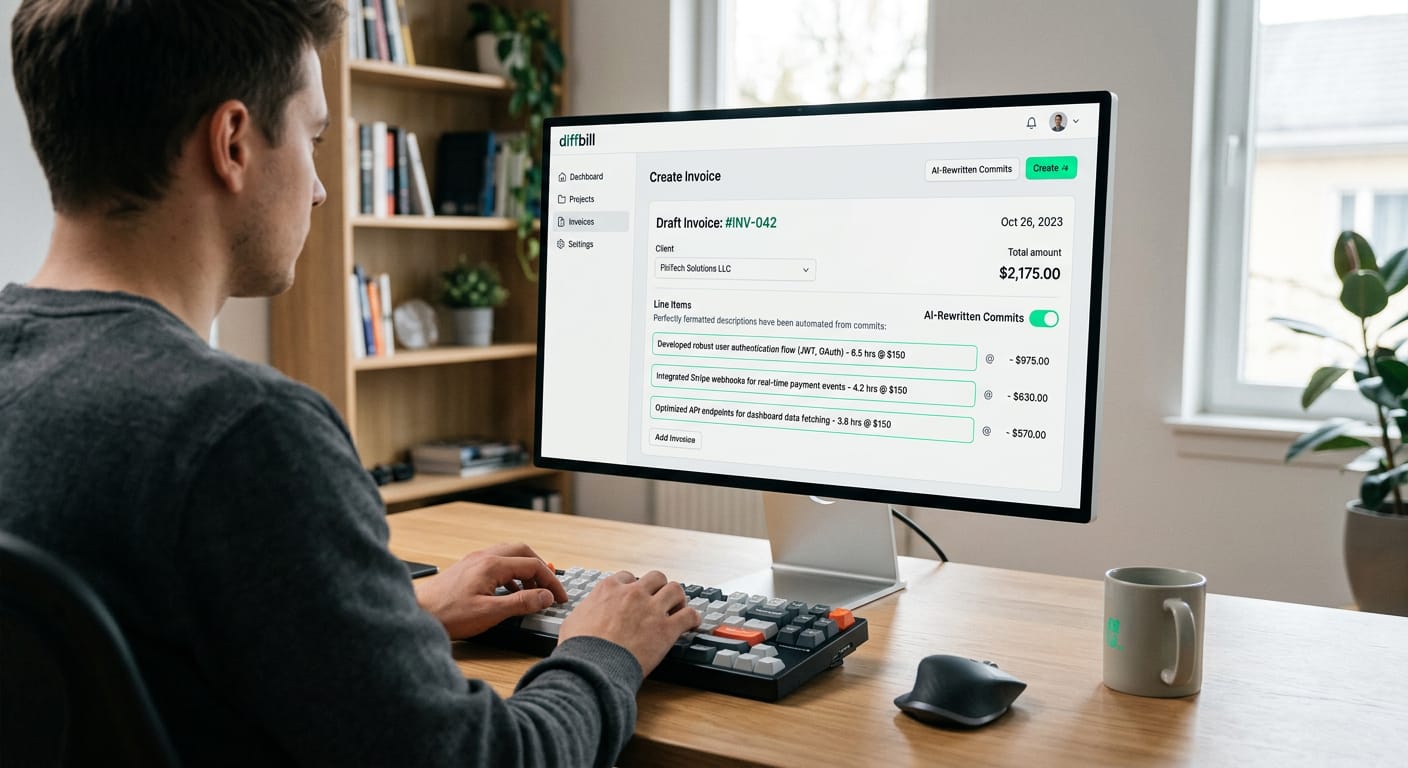
As you wrap up your developer invoicing software comparison, remember that investing in a workflow built around your repository will pay dividends instantly. Adopting a specialized pro plan gives you deep per-client tone control and formatting customization while keeping you out of the administrative weeds. You can confidently send out accurate, polished billing summaries and get right back to your code.
Start billing