
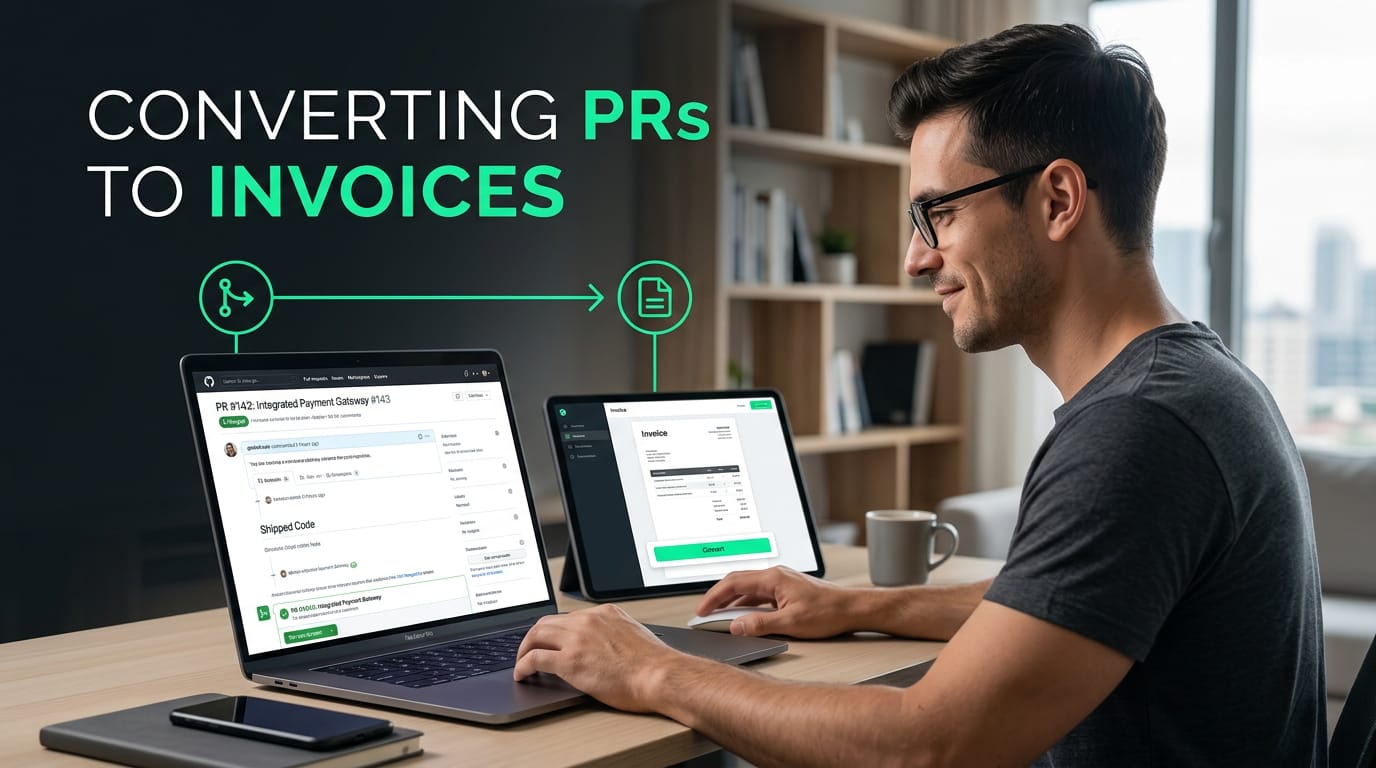
How to Convert a PR to an Invoice: The Developer's Guide
Stop manually summarizing git commits. Learn how freelance developers can convert GitHub Pull Requests directly into Stripe invoice drafts.
Learn how to turn shipped code into cash by converting GitHub Pull Requests directly into professional, client-ready invoices.
What it Means to Convert a PR to an Invoice
When you make a living writing code, your unit of work isn't always a timesheet—it's shipped features and resolved issues. To convert a PR to an invoice means taking the code you've successfully merged and directly translating it into a billable line item for your client. Instead of manually retyping Git commit messages into a spreadsheet at the end of the month, you use your repository's history to build your final bill.
The developer's definition of a PR
If you search for developer invoicing automation strategies to streamline this workflow, you'll quickly run into a frustrating terminology clash. Traditional accounting software uses "PR" to mean a Purchase Request, focusing on flipping procurement documents into vendor bills. But modern developers live in GitHub, where a PR strictly means a Pull Request. For freelance engineers and consultants, turning merged code into a structured financial document is the final—and often most tedious—step of a project.
You need to translate highly technical work into a professional receipt that a client's finance department can easily approve. When you successfully convert PR to invoice line items, you bridge the gap between your engineering workflow and your client's accounting team. Doing this effectively involves a few key transformations:
- De-jargoning: Rewriting terminal-friendly commit messages into business-friendly value statements.
- Aggregating: Grouping multiple related Pull Requests into a single, cohesive project milestone.
- Proving value: Providing a source-linked audit trail so clients know exactly what code they are paying for.
Ultimately, tying your billing strictly to your version control provides total transparency. It removes the manual friction from end-of-month reporting and ensures you get paid accurately for the exact units of work you delivered.
The Old Way: Manual Translation and Copy-Pasting
When it comes time to convert PR to invoice, manually scraping your commit history is a massive drain on your development time. You are forced to dig through weeks of closed pull requests just to remember exactly what you shipped for a client. Instead of writing code, you end up playing detective in your own repositories to piece together your billing cycle.
The biggest hurdle isn't just finding the work; it's translating it. You have to take highly technical jargon like "refactored auth middleware" and rewrite it into a value-driven summary a non-technical client will happily pay for. This tedious context switching forces you out of a deep work state and directly into billing ops quicksand.
The True Cost of Manual Billing
Every minute spent staring at a blank Stripe dashboard and copy-pasting descriptions delays your payday. The typical status quo steals hours from your month that could have been spent on billable client work or building your own projects. It turns the exciting moment of getting paid into a dreaded monthly chore.
Relying on memory and manual data entry also leaves room for missed line items, meaning you might be underbilling on small fixes and leaving money on the table. When you evaluate this old workflow against modern automation, you quickly see how much energy is wasted trying to convert PR to invoice manually month after month. You need a system that captures your shipped code instantly so you can focus on building, not billing.
How to Automate Pull Request Invoicing with diffbill
The fastest way to get paid for shipped code is to remove yourself from the billing bottleneck. Instead of manually copying commit histories into generic accounting software, you can convert PR to invoice drafts automatically without leaving your keyboard. Diffbill connects your GitHub repositories directly to Stripe, scanning for closed pull requests to automate client invoicing from GitHub activity and translating developer jargon into polished line items.
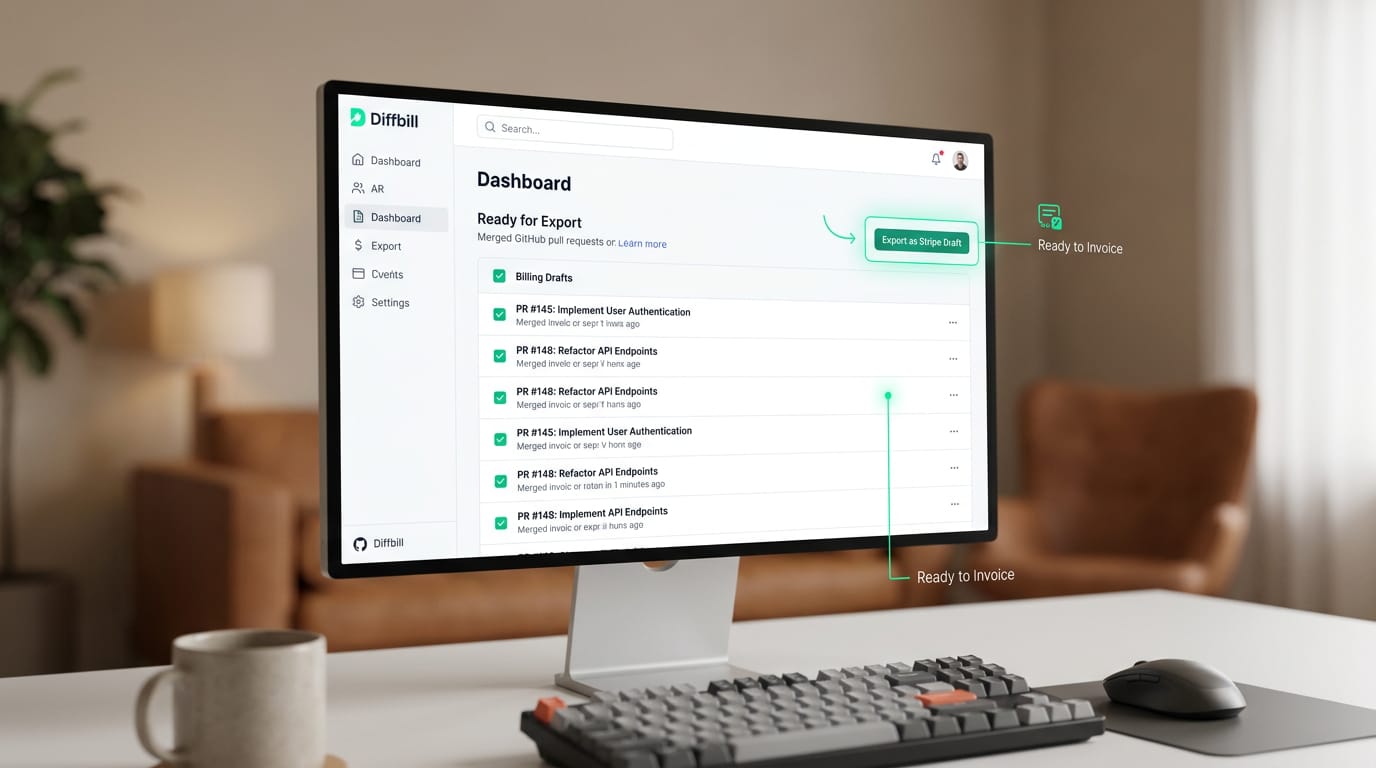
The automated billing workflow
Connect your repositories
Sync merged PRs
Review and push to Stripe
Traditional accounting platforms are built for standard purchase orders, not agile development cycles. When you use a developer-first tool to convert PR to invoice records, custom AI handles the tedious work of rewriting technical descriptions into professional language. You completely eliminate the manual data entry and context-switching that slows down your end-of-month billing.
The diffbill Starter Plan provides a completely free entry point for individual developers managing a single tracked repo. It includes basic AI rewriting and default redaction, making it the perfect way to test basic billing automation without any upfront investment.
Start billing for free
Rewriting Developer Jargon into Client-Friendly Line Items
When you convert a PR to an invoice, the biggest bottleneck isn't usually the accounting software itself—it's the translation layer. Your client doesn't care that you bumped a dozen standard library dependencies or refactored a brittle API endpoint. They care that their checkout page is now faster and secure from critical vulnerabilities.
Manually rewriting git logs into billing descriptions forces you into a tedious context switch. You end up digging through closed pull requests at the end of the month, trying to remember exactly what business value a cryptic commit message actually delivered. This manual process leaves room for miscommunication, and confused clients are much more likely to push back on line items or delay your payment.
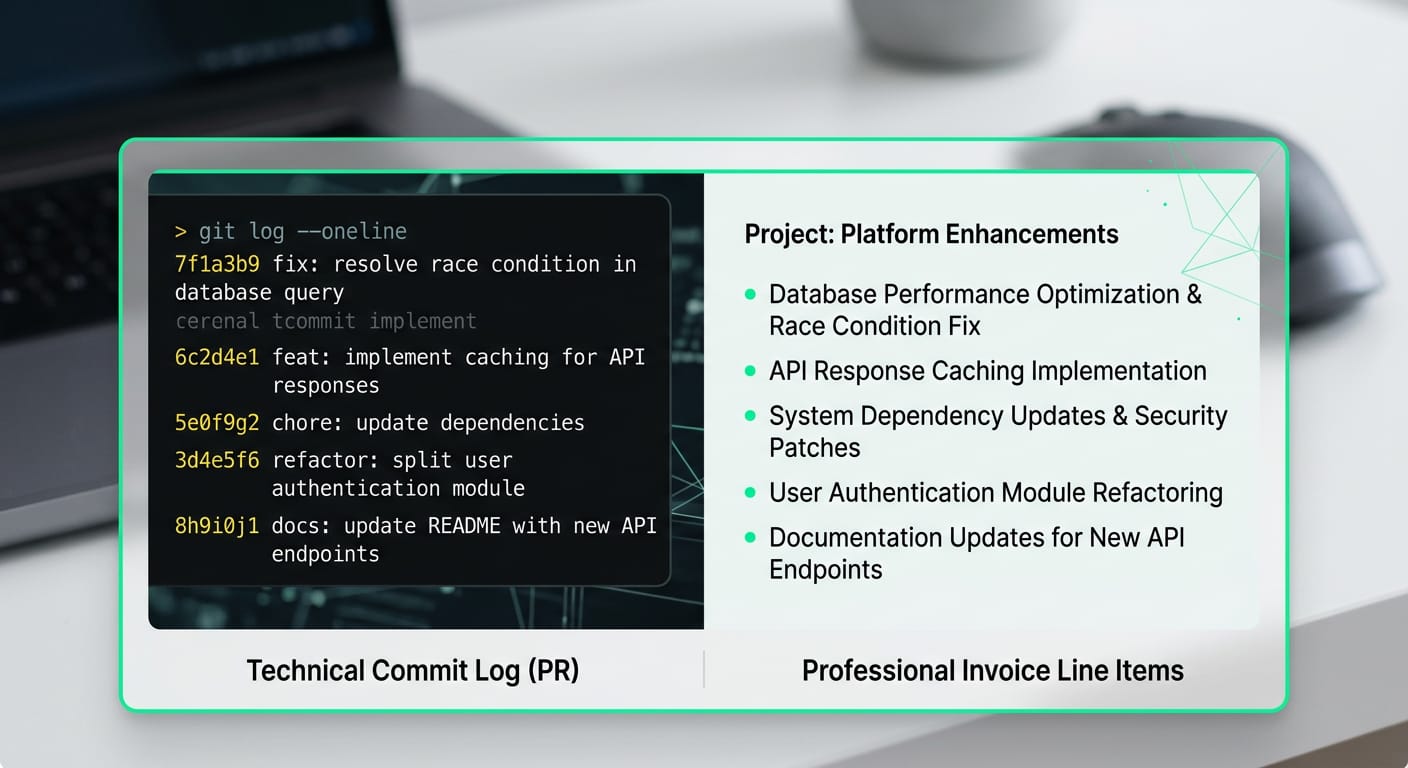
AI-Powered Translation for Billing
Modern automation completely removes this friction from your workflow. By analyzing your pull request descriptions and code diffs, AI tools can instantly map deep technical implementations to clear, professional business outcomes. Instead of wrestling with spreadsheet templates, you get client-ready language that highlights the true ROI of your shipped code.
If you want to pressure-test the output on one real pull request first, try the free PR to invoice line item generator. It gives you three client-facing variants and a redacted version without signup.
Relying on an automated summary offers clear advantages over manual entry:
- Reduces client pushback: Clear, outcome-focused language builds immediate trust.
- Accelerates payment: Clients authorize invoices faster when they easily understand what they are paying for.
- Adapts to your audience: Per-client tone controls let you dial the verbosity up or down depending on a specific client's technical fluency.
While traditional AP platforms are built around flipping purchase orders or tracking raw hours, developers need billing tools built around code. When you go from a merged PR to client-ready line items automatically, every drafted entry is seamlessly linked back to a tangible repository update. This source-linked audit trail proves your value to clients without requiring you to write a single extra line of text.
Building Trust with Source-Linked Audit Trails
Building an immediate foundation of trust is the easiest way to keep high-value consulting clients around for the long haul. When you seamlessly convert a PR to an invoice, you aren't just sending a bill—you are providing a transparent record of your shipped code. Allowing a client to click directly from a polished invoice line item back to the original GitHub pull request removes all ambiguity about what they are paying for.
Key Takeaways
- Never lose billable work in forgotten GitHub PRs.
- AI translation turns technical work into business value automatically.
- Source-linked invoices build absolute trust with stakeholders.
The Power of Verifiable Work
Traditional financial tools might let you flip a generic purchase order into a bill, but they completely disconnect your deep technical execution from the final price tag. If your monthly invoice simply lists "database optimization," non-technical stakeholders might question the hours you logged. A source-linked audit trail eliminates this friction by serving as undeniable proof of work.
Instead of fielding subjective questions about your timesheet at the end of the month, linking your billing directly to your code repository creates immediate benefits:
- Fewer billing disputes: Clients can easily verify the exact commits, PR discussions, and code changes behind every line item.
- Faster payment cycles: Transparent, evidence-backed invoices give accounting teams the confidence to approve payouts without hesitation.
- Stronger partnerships: Exposing your exact output proves your ongoing value, making it easier to negotiate retainer renewals or future rate increases.