

Legal Requirements for Freelance Developer Invoices: A Complete Guide
A comprehensive guide to the legal requirements for freelance developer invoices, covering non-negotiable details, verifiable service descriptions, and payment terms.
Learn the essential legal elements every freelance developer invoice must include to ensure prompt payment, clarify project scope, and protect your business.
What makes a freelance developer invoice legally binding?
An invoice acts as a formal record of your delivered code and a contractual request for payment. To meet the legal requirements for freelance developer invoices, the document must include specific identifying details. Without these markers, an invoice cannot legally prove a transaction occurred.
When you submit a bill, you create a permanent paper trail of your business agreement. According to Source 3, proper invoicing offers crucial legal protection because it outlines the exact services rendered and the agreed-upon rates. This documentation provides essential evidence if a client ever disputes the scope of your work or delays a milestone payment.
Core functions of a compliant invoice
To ensure your billing is legally sound and professional, every document must accomplish a few specific goals. Relying on an informal email or a chat message to request payment leaves your business vulnerable to scope creep and unpaid invoices.
Key Takeaways
- Compliance: Satisfy local tax regulations by clearly identifying the buyer, the seller, the date of issue, and a unique invoice number.
- Clarity: Detail the exact project scope, pull requests, and code deliverables so the client knows precisely what they are paying for.
- IP Protection: Clarify when the intellectual property rights for your code transfer to the client, which typically occurs only after full payment.
Treating your invoices as formal legal documents protects your growing freelance business. Mastering the legal requirements for freelance developer invoices guarantees that you and your client share a strict understanding of the financial terms. As noted in Source 1, this level of professional documentation prevents the costly misunderstandings that often lead to unpaid technical work.
The non-negotiable legal checklist for developer invoices
The baseline legal requirements for freelance developer invoices revolve around clear identification and accurate record-keeping. To create a legally binding billing document, you must include your professional business details, the client's contact information, a unique sequential invoice number, specific payment dates, and an itemized breakdown of your deployed services.
Skipping these mandatory components does more than just delay your payouts. According to Source 3, an invoice functions as a formal legal document that outlines your agreement and provides crucial evidence if a payment dispute arises. Treating your billing documents with the same precision as your codebase ensures you stay compliant with local tax regulations and protects your business from liability.
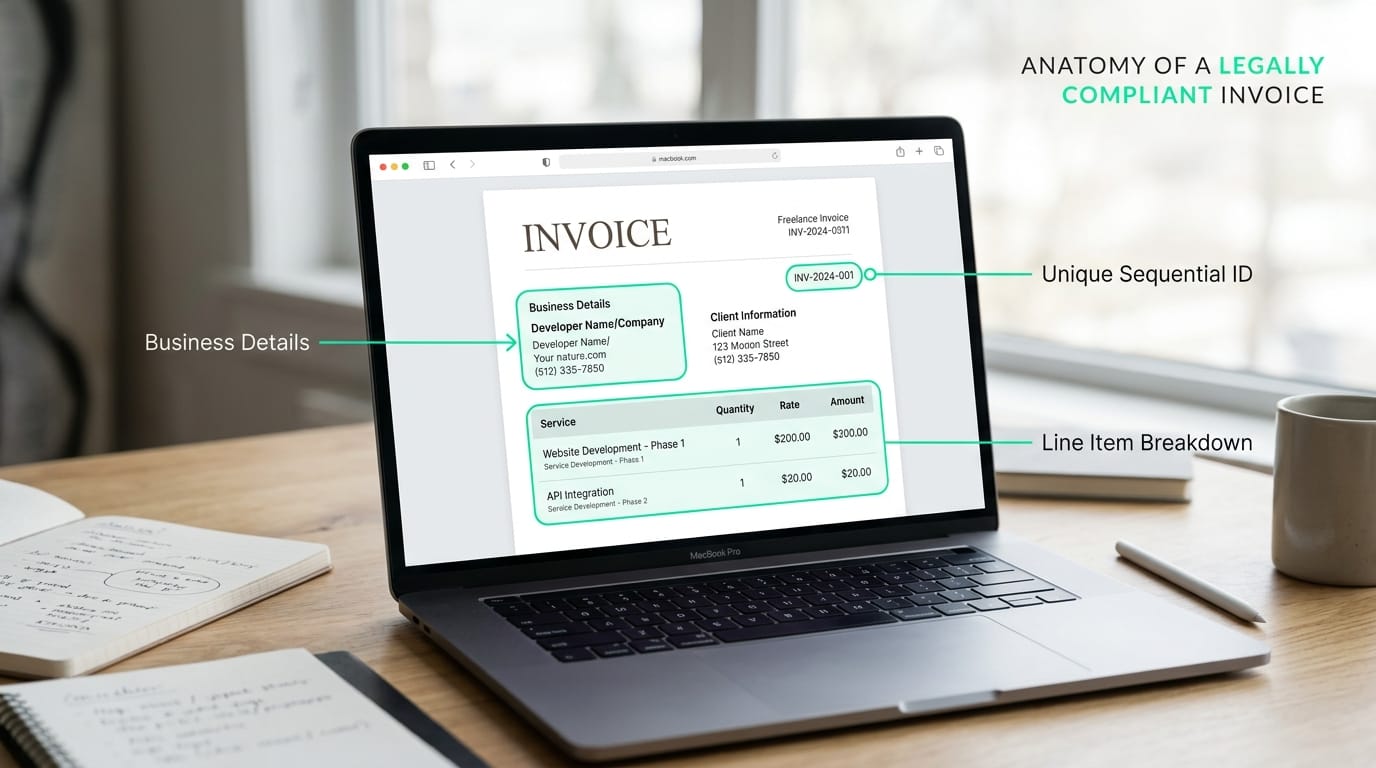
Core elements of a compliant invoice
Every professional invoice requires specific data points to be valid for your client's accounting department and your own audit trails. Based on standard invoicing practices highlighted by Source 1 and Source 4, make sure your billing process always captures:
- Explicit Headers: The word "Invoice" prominently displayed at the top so the document's purpose is undeniable.
- Complete Contact Data: Your legal business name, address, and email, alongside the exact legal name and billing address of the client paying you.
- Tax Identification: Your VAT, GST, Employer Identification Number (EIN), or local tax ID, depending on your jurisdiction and business structure.
- Dates and Sequencing: The issue date, explicit payment due date, and a unique, sequential invoice number to prevent duplicate billing.
| Invoice Element | Legal Purpose | Best Practice Example |
|---|---|---|
| Unique Invoice Number | Prevents duplicate payments and creates a clear audit trail. | INV-2023-042 |
| Business Information | Establishes the legal entity requesting the payment. | Jane Doe / Acme Dev LLC, 123 Tech St. |
| Service Description | Defines the exact scope of work delivered for the fee. | React frontend implementation (40 hours) |
| Dates and Terms | Sets the legal timeline for payment and validates any late fees. | Issued: Oct 1, Due: Oct 15 (Net 15) |
Clarifying scope: Why precise service descriptions matter
Meeting the core legal requirements for freelance developer invoices means ensuring your line items explicitly match the scope of work defined in your master contract. Vague descriptions like "wrote code" or "fixed bugs" create ambiguity, making it incredibly difficult to defend your work if a client disputes a charge or delays payment.
According to Source 3, invoices serve as binding legal documents that outline the specific terms of your agreement. If your invoice descriptions do not clearly map back to project milestones or expected deliverables, you leave yourself vulnerable to scope creep and chargebacks. A clear, professional breakdown proves exactly what value you delivered, helps you avoid underbilling on small fixes, and validates your agreed-upon rate.
Translating commits into compliance
Clients rarely understand raw Git commits or highly technical jargon. Translating your technical pull requests into plain, professional language builds trust and eliminates back-and-forth questions about what they are paying for. As Source 1 notes, providing a detailed breakdown of the services rendered is an essential element of maintaining a professional and legally protected freelance relationship.
To ensure your service descriptions protect your freelance business, verify these details before sending your next bill:
- Reference specific milestone names or deliverable titles directly from your statement of work.
- Include the dates or date ranges when the specific implementation was performed.
- Focus on the business value or outcome rather than just the strict technical commands run.
Structuring payment terms, late fees, and IP transfer
To meet the core legal requirements for freelance developer invoices, you must clearly state your payment timelines, late fee policies, and intellectual property (IP) transfer conditions. These elements act as a binding agreement that ensures you get paid on time while protecting the codebase you build. Establish these expectations clearly before you write a single line of code (Source 2).
Setting clear payment timelines and late fees
Setting a specific payment window removes ambiguity around when a client actually owes you money. Proper invoicing serves as a specific legal document that protects you during payment disputes (Source 3), so your terms must be completely explicit.
To keep your cash flow predictable and legally enforceable, include these financial details on every invoice:
- Payment terms: Use standard industry timelines like "Net-15" or "Net-30" to indicate the client has exactly 15 or 30 days from the invoice date to clear the balance.
- Enforceable late fees: State what happens if the payment window is missed to encourage prompt payment. Most freelancers clearly list a standard late fee of 1.5% to 2% per month on the overdue balance.
- Legal limits: Ensure your specific late fees comply with your local jurisdiction. Many regions legally cap the maximum allowable interest rate you can apply to an unpaid invoice.
Protecting your code with IP clauses
Your code is your primary leverage in any freelance contract. By default, the intellectual property rights to the software or website you develop belong to you until you explicitly transfer them to the client (Source 1). Your invoice should clearly state that the copyright and IP rights for the deliverables only transfer once the total balance is completely paid. This formally prevents a client from using, modifying, or deploying your code if they decide to skip out on their final bill.
Frequently asked questions about independent billing
Navigating the legal requirements for freelance developer invoices doesn't have to be complicated. Most independent developers face similar hurdles when setting up their business operations, from licensing confusion to terminology overlap. Here are the direct answers to the most common questions about independent billing.
Automating accurate, client-ready invoices from your codebase
Meeting the legal requirements for freelance developer invoices often creates a frustrating workflow bottleneck for independent engineers. Manually translating complex Git commits into clear, legally compliant line items drains your time and energy. By choosing to automate client invoicing from GitHub activity, you guarantee that your billing is accurate, completely auditable, and professionally formatted.
The friction of manual billing usually starts at the end of a sprint. You have to review your merged code, estimate the hours spent, and strip out technical jargon so the client's accounting department understands what they are actually paying for. According to Source 3, your invoice serves as a formal legal document detailing the exact services rendered. If your line item descriptions are overly technical or confusing, you risk delayed payments and unnecessary client disputes.
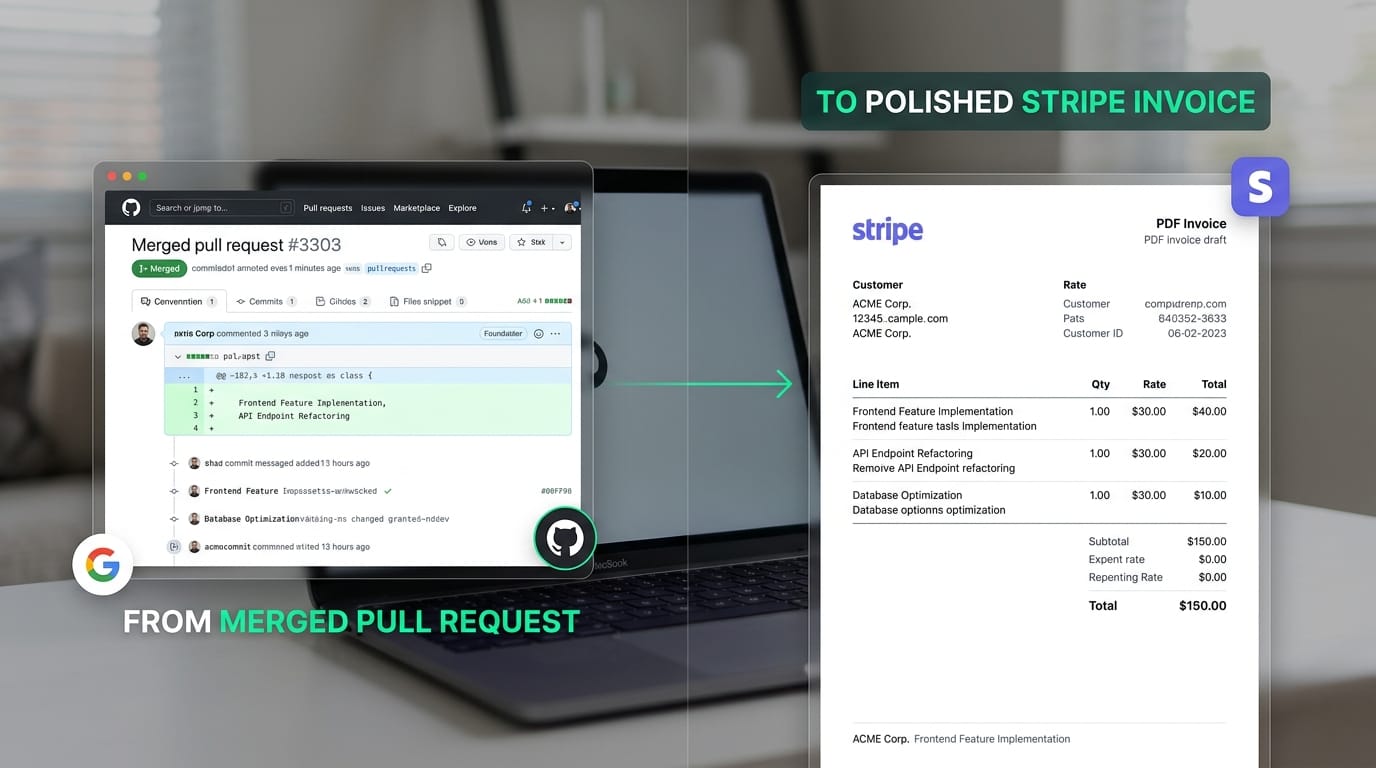
Bridging the gap between your codebase and billing
Connecting your version control system directly to your financial software removes the guesswork from your invoicing cycle. Instead of relying on subjective memory or manual developer time tracking software, you can pipeline your shipped work straight into a draft. An AI invoice generator for freelancers instantly rewrites highly technical engineering tasks into polished, client-ready business language.
Autom...