

Billing Automation for Software Development Lifecycle: Connecting Code to Cash
Discover how integrating billing automation directly into your software development lifecycle transforms merged GitHub PRs into client-ready invoices.
Learn how connecting your GitHub workflow directly to your invoices saves hours of administrative work, reduces context-switching, and gets freelancers paid faster.
The Disconnect Between Shipping Features and Getting Paid
Many developers treat billing as a disconnected, end-of-month chore rather than a natural extension of their development process, wasting hours trying to retrace their steps.
Without billing automation for software development lifecycle management, a massive gap forms between writing code and actually collecting revenue. You might merge multiple pull requests in a single afternoon, but translating those technical updates into professional invoices often drags on for days. This manual administrative work creates a frustrating bottleneck that directly delays your cash flow.
The High Cost of Git History Archaeology
Waiting until the end of the month to compile invoices forces you into the role of an archeologist. You waste valuable time digging through weeks of tangled Git histories and closed Jira tickets just to remember what you actually built. Every minute spent hunting down forgotten commits and rewriting them for non-technical stakeholders is a minute you cannot bill for new feature development.
Relying on this manual look-back method introduces several quiet risks to your consulting business:
- Revenue leakage: Forgetting to document minor bug fixes or small, incremental updates leaves hard-earned money on the table.
- Delayed cash flow: Procrastinating on tedious invoice generation means bills go out late, pushing your actual payday even further back.
- Client friction: Pasting highly technical commit messages directly into an invoice often confuses clients and triggers questions that delay invoice approval.
Treating your billing as an isolated event at the end of a sprint guarantees inefficiency. Capturing the value of your work the moment a feature ships eliminates the end-of-month panic and ensures you get paid for every line of code you deliver.
Integrating Billing Automation Directly into Your SDLC
The most accurate record of your work already exists in your version control system. Instead of treating invoicing as a separate administrative chore, integrating billing automation for software development lifecycle workflows turns your daily coding milestones into financial events. Every time you merge a pull request, you are delivering business value that should immediately trigger your billing pipeline.
Traditional billing models force developers into a jarring context switch. At the end of the month, you have to pause your engineering work to dig through commit histories, translate technical updates into client-friendly language, and manually generate invoices. This tedious data entry inevitably leads to forgotten line items, delayed payments, and wasted billable hours.
Moving to Event-Driven Invoicing
Modern financial workflows rely on event-driven infrastructure. Just like a push to your main branch triggers a deployment, merging a pull request can act as an automated trigger for your invoicing system. Connecting your repository directly to your payment gateway ensures that the moment your code ships, your ledger updates.
Merge Code
Translate Diff
Draft Invoice
Evaluating this type of automated workflow against traditional manual accounting reveals several critical advantages for tech professionals:
- Zero context switching: You stay fully focused in your editor and repository while line items generate in the background.
- Complete revenue capture: Minor bug fixes and small PRs that normally slip your mind at the end of the month are automatically tracked.
- Verifiable client transparency: Invoice items tie directly back to specific repository events, giving clients absolute clarity on the exact work they are funding.
Manual Invoicing vs. Automated SDLC Billing
The biggest drain on a freelance developer's energy isn't writing complex code; it's the administrative headache that comes after the work is done. Implementing billing automation for software development lifecycle tasks fundamentally shifts how you manage your independent business. Instead of ending your month buried in spreadsheets, you can connect your code repository directly to your cash flow.
In a traditional manual workflow, generating invoices requires continuous, exhausting context-switching. You end up scouring old git logs, issue trackers, and pull requests just to remember exactly what you shipped weeks ago. Then comes the tedious task of translating technical jargon—like "refactored JWT payload structure"—into professional line items that your non-technical clients actually understand and value.
Achieving True Cognitive Ease
The most immediate benefit of an automated SDLC billing process is pure cognitive ease. You no longer have to keep a running mental log of every patch, dependency update, and minor bug fix for your client. When you step out of the codebase, your invoicing system is already prepped with the exact value you delivered.
Transitioning to a developer-first automated billing setup provides several tangible upgrades to your workflow:
- Zero context-switching: Stay focused in your terminal and editor while your billing administration happens in the background.
- Professional translation: AI tools automatically convert hyper-technical commit messages into client-friendly deliverables.
- Accurate revenue tracking: Every merged pull request is captured, ensuring you never leave unbilled hours on the table.
Evaluating this workflow tradeoff is straightforward. You can continue losing unpaid hours piecing together git histories, or you can adopt a system that treats invoicing as an extension of your source control. Seamless billing automation for software development lifecycle management ultimately lets you focus on building great software, knowing the administrative busywork is already handled.
Features to Look For in Developer-Centric Billing Tools
Generic invoice generators force you to step outside your natural workflow just to get paid. For freelancers and consultants, implementing billing automation for software development lifecycle stages is the key to minimizing this administrative overhead. The right tool bridges the gap between your code repository and your bank account, ensuring every shipped feature translates directly into revenue.
Your workflow already centers around version control, so your invoicing software needs to live there, too. Look for systems that offer direct integrations between where you write code, like GitHub, and where you manage money, like Stripe. When you merge a pull request, the system should instantly capture that milestone to draft a corresponding invoice line item.
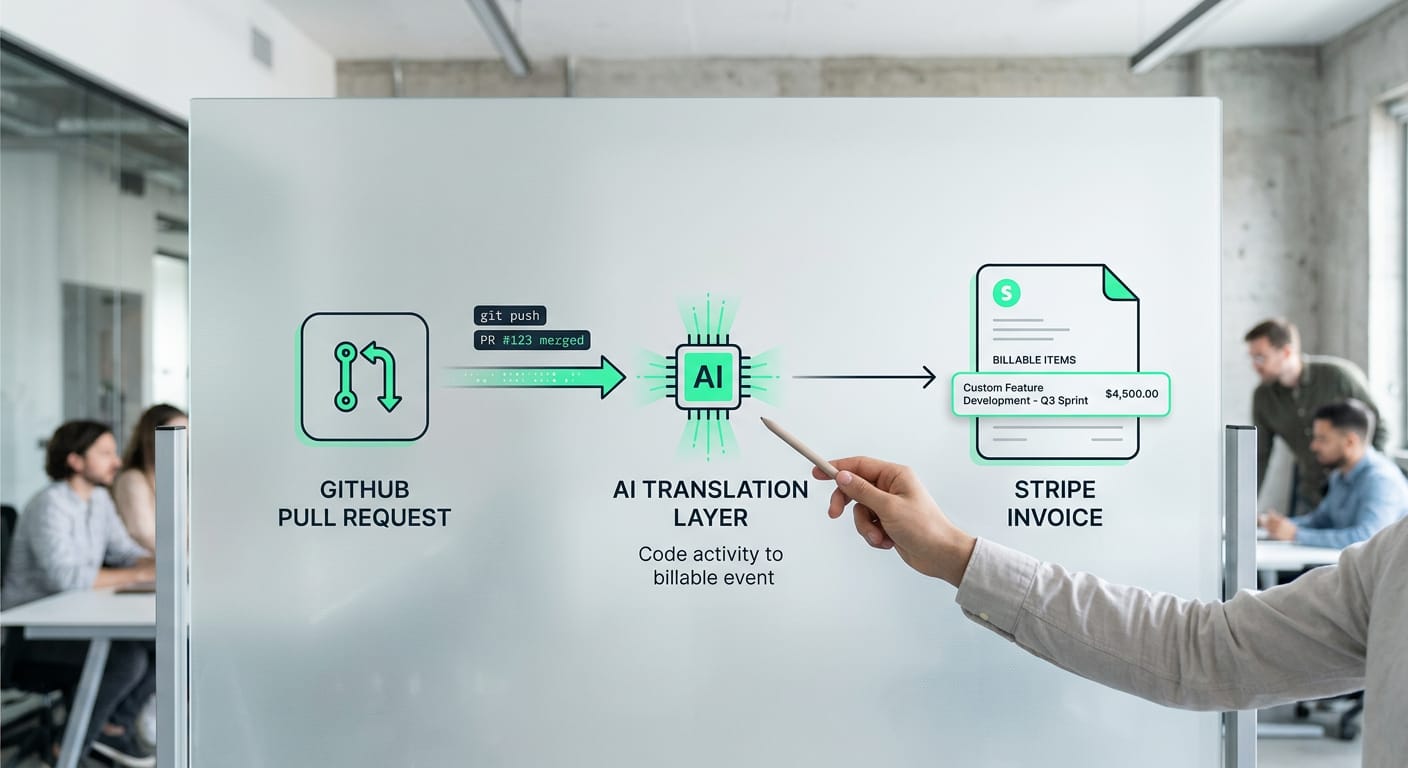
Essential Features for Consultants
Evaluate any developer-centric billing platform against these specific workflow requirements to ensure it actually saves you time:
- Direct repository integrations: Seamless connections from GitHub to Stripe eliminate manual data entry and track your exact progress.
- Per-client tone controls: Built-in translation layers convert technical jargon into business value that non-technical stakeholders easily understand.
- Source-linked audit trails: Invoices that link directly back to specific pull requests provide absolute transparency for your clients.
Clients often push back on invoices when they do not understand the highly technical deliverables listed on the page. When you set up billing automation for software development lifecycle events, every merged PR can be automatically rewritten to highlight the actual business outcome. This prevents your client's finance team from stalling payments over confusing Git commit messages.
Finally, absolute transparency is what guarantees long-term trust with your freelance clients. A source-linked audit trail allows anyone reviewing the invoice to click through and verify the exact work completed. This level of verifiable proof removes friction from the approval process, reduces context-switching, and ultimately gets you paid faster.
Automating Your End-to-End Workflow with Diffbill
The most immediate benefit of implementing scalable billing automation for software development lifecycle processes is realizing you no longer have to manually translate technical commits into client-friendly invoices. Instead of piecing together fragmented spreadsheets and time-trackers, you can use diffbill as the ultimate bridge between your repository and your payment gateway. It automatically transforms merged GitHub pull requests into professional Stripe invoice drafts. This seamless connection turns your deployed code directly into cash flow without the usual administrative friction.
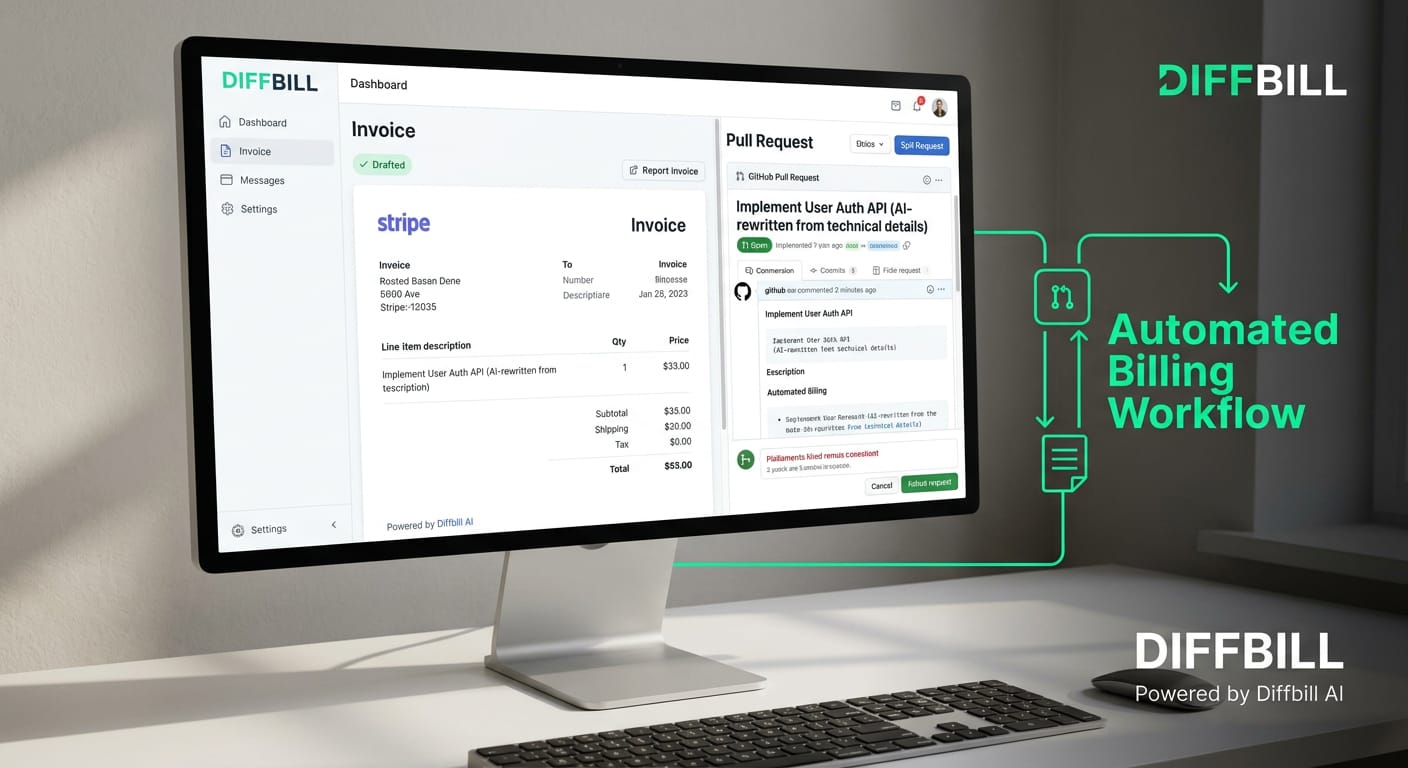
Manually detailing what you shipped at the end of every week wastes valuable context-switching time. By bridging GitHub and Stripe directly, diffbill saves independent developers roughly five minutes per pull request. Over the course of a busy month, that translates to reclaiming more than three hours of billable time. You get to focus your energy entirely on shipping features rather than hunting down old commit messages.
Upgrading the freelance workflow
When you are ready to remove branding and optimize your administrative speed, the Pro Plan provides the advanced features needed to run a refined freelance business. You get strict control over how your hard work is presented, stripping out internal jargon before the client ever sees the bill. This paid tier enhances your productivity by adapting to the way developers naturally work.
- Per-client tone controls: Customize how the AI rewrites your technical descriptions so the language matches each specific client's expectations.
- Keyboard-first workflows: Navigate, edit, and approve your pending invoice drafts efficiently without ever needing to reach for your mouse.
- Source-linked audit trails: Provide absolute transparency by linking your billed line items directly back to the original GitHub pull requests.
Stop letting administrative bottlenecks delay your accounts receivable. Connect your tools today and let your development workflow generate your invoices automatically.
Start billing