

How to Automate Invoicing for IT Companies
Discover how IT companies and freelance engineers can automate their invoice processing, reduce admin time, and turn GitHub PRs into paid Stripe invoices.
Learn how to eliminate manual data entry and recurring billing headaches by automating your IT company's invoicing workflow—directly from shipped code to client-ready drafts.
What is automated invoice processing for IT?
Automated invoice processing uses specialized software to capture, validate, and process billable work without manual data entry. If you are researching how to automate invoicing for IT companies, the most effective approach connects your engineering delivery tools directly to your financial system to eliminate repetitive billing tasks.
Traditionally, generating invoices involves reviewing issue trackers, manually entering line items, and hunting down ticket approvals. Automation replaces these tedious workflows by using direct integrations and artificial intelligence to translate completed deliverables into client-ready drafts. According to Source 2, utilizing software to handle these steps significantly reduces manual data entry, saving administrative time and minimizing costly human errors.
Core steps of an automated billing workflow
For development agencies and freelance engineers, modern financial platforms bridge the gap between project management and accounting. When exploring the best billing software for IT companies, look for systems that capture billable events the moment the work is shipped. A streamlined process typically handles three tedious phases:
- Data capture: Automatically extracting completed units of work, such as synced GitHub pull requests, directly into your billing dashboard.
- Data translation: Rewriting highly technical commit messages or project logs into professional line items that non-technical clients can easily understand.
- Draft generation: Pushing those verified line items into your payment gateway to create pending invoice drafts for a quick final review.
Setting up this level of direct integration ensures your accounts receivable workflow scales predictably alongside your client base. Source 1 notes that minimizing manual invoice creation eliminates the administrative bottlenecks that frequently cause delayed revenue and late payments. By removing these repetitive financial chores, development teams can spend less time auditing their past work and more time writing impactful code.
Why IT businesses should automate their billing workflows
Figuring out exactly how to automate invoicing for IT companies usually forces teams to confront a painful reality: manual billing drains expensive engineering hours. Instead of writing code, developers lose valuable time context-switching to compile billable hours, map repository commits to line items, and chase down late payments. When you replace manual data entry with an automated workflow, you reduce the time it takes to get an invoice out the door to almost zero.
The hidden costs of manual billing
Relying on disconnected or copy-pasted invoice drafts disrupts reliable cash flow. Over 50% of U.S. small businesses now rely on credit or loans just to survive late payments caused by these administrative bottlenecks (Source 1). Traditional invoice processing can involve up to 15 separate menial steps—from extracting provider data to routing internal approvals—which introduces high rates of human error (Source 3).
Connecting your code repositories directly to your payment gateway solves this structural inefficiency. Setting up an automated invoice processing system translates your development cycles into predictable, steady revenue.
- Captures data instantly: Billing automation extracts data directly from your shipped pull requests and maps it to the correct invoice fields without manual data entry (Source 3).
- Speeds up client delivery: Automated systems replace tedious copy-pasting by logging and organizing line items as soon as your code ships.
- Protects business liquidity: By eliminating the administrative lag between shipping work and billing for it, you fix the cash flow delays that typically stall business growth (Source 1).
How to automate IT invoicing in 4 steps
Transitioning your IT consulting business to an automated system means connecting your shipped code directly to your payment processor. Figuring out how to automate invoicing for IT companies typically requires four steps: integrating code repositories, using AI to translate technical notes, reviewing line items, and syncing to a billing gateway.
Manual task tracking demands constant context switching between GitHub and your accounting software. According to Source 2, using software to automate these processing steps significantly reduces redundant manual data entry and minimizes costly billing errors. By bridging your engineering stack and your financial tools, you build a reliable pipeline where billable work organizes itself.
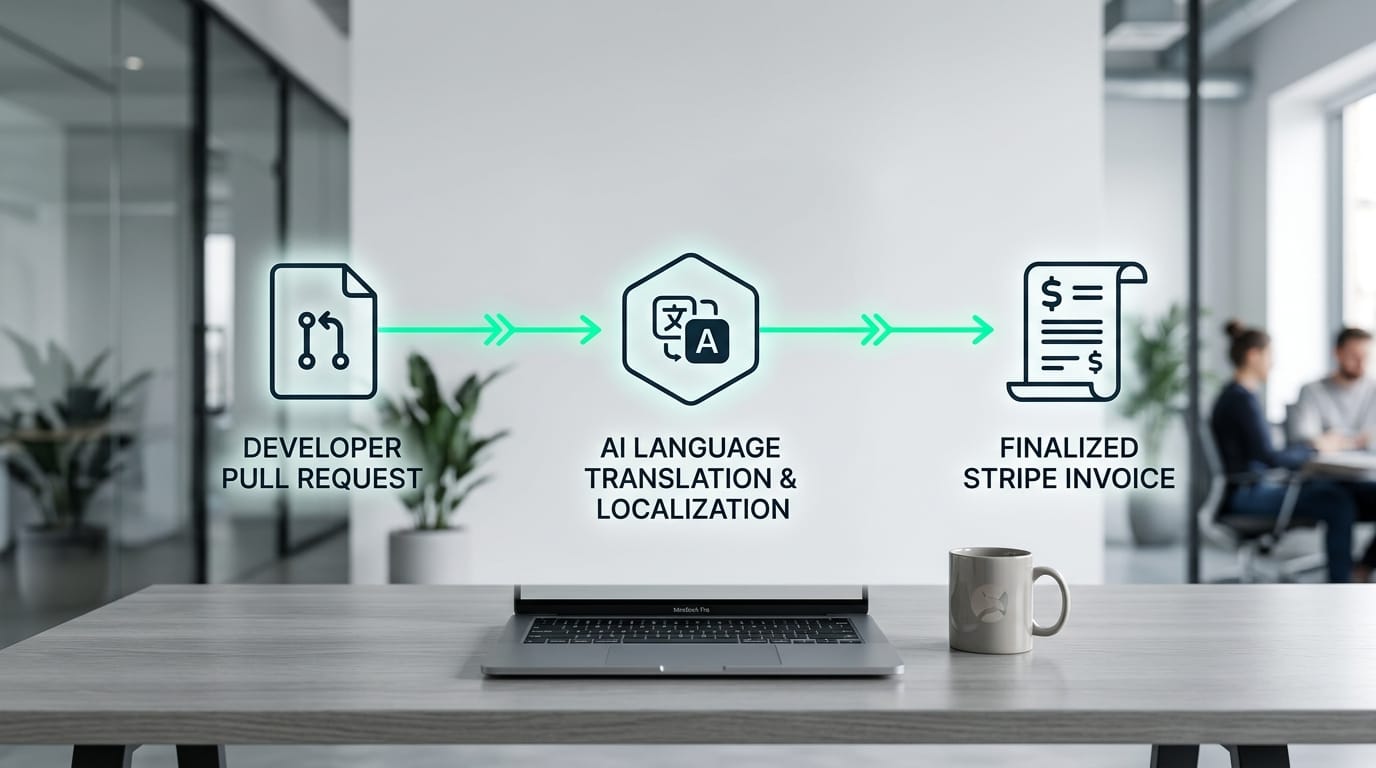
Connect your repositories
Translate with AI
Review the audit trail
Sync to payment gateway
Connecting code output to cash flow
Once you map your version control system to your billing pipeline, automation manages the heavy lifting of converting git commits into client deliverables. AI tools analyze complex technical inputs and generate readable line items instantly, cutting out hours of menial end-of-month data entry (Source 3).
However, streamlining your generation process does not mean losing oversight. A centralized dashboard lets you review each line item and verify the underlying pull requests before any bill is finalized. Syncing this clean data directly into your payment processor enables easy tracking and allows you to set up recurring payments, ultimately improving cash flow predictability (Source 1).
Manual data entry vs. automated billing pipelines
Figuring out how to automate invoicing for IT companies starts by abandoning copy-and-paste workflows. An automated billing pipeline links your source code directly to your invoice drafts, removing the need to manually rewrite task titles or calculate pricing in a spreadsheet.
The traditional accounting method forces developers into tedious administrative tasks. You have to comb through technical commit messages, translate them into business language for non-technical clients, and double-check pricing line items. This manual invoicing cycle is bloated and highly prone to human error, which Source 3 notes can sometimes involve up to 15 separate administrative steps just to get a bill out the door.
Pipelines over spreadsheets
Implementing an automated pipeline removes this friction entirely by treating your shipped work as the single source of truth. As soon as code is merged, the system captures the data, redacts sensitive internal references, and begins translating technical work for client invoices by turning technical shorthand into clear, client-ready language. It is a massive time-saver for technical teams, driving rapid adoption of automation software that is now valued at almost $3.4 billion (Source 2).
Implementing solid developer invoicing automation strategies handles the menial tasks so you can focus on coding:
- Secure data extraction: Pulling titles and complete work directly from your repository layer.
- Tone translation: Automatically rewriting developer jargon into a professional tone tailored for business stakeholders.
- Audit transparency: Connecting the final invoice directly to the shipped pull requests to prevent billing disputes.
Common invoicing automation FAQs for developers
If you are researching how to automate invoicing for IT companies, handling secure code data and complex billing tasks is likely your top concern. Modern billing automation systems solve this by safely extracting repository metadata and using AI to translate technical work into clear, client-ready line items.
Resolving common technical barriers
Connecting new billing tools to your current technology stack requires platforms that smoothly handle both routine transactions and unexpected edge cases. According to Source 2, effective automated processing systems rely on a few key mechanics to manage complex workflows:
- Data extraction: Systems precisely map specific metadata fields so the software reliably captures billable hours and task descriptions without manual entry.
- Exception handling: Outliers and complex multi-step invoices are automatically flagged and logically routed to predefined approval workflows rather than breaking the system.
- Seamless integration: Modern platforms sync directly with your existing accounting tools to maintain a clear, single source of truth for your finances.
For developers billing directly from version control, the idea of connecting external software often raises immediate security red flags. Fortunately, you never have to expose your proprietary codebase just to eliminate manual data entry. Invoicing automation acts as a secure bridge, pulling only the necessary non-sensitive context to generate an accurate billing history.
Streamline your IT invoicing with diffbill
Figuring out how to automate invoicing from a GitHub repo starts by connecting your billing workflows directly to your codebase. Instead of navigating up to 15 manual administrative steps just to process a single payment (Source 3), an automated system transforms your merged GitHub pull requests directly into client-ready Stripe invoice drafts.
Administrative delays have real consequences, as traditional late payments can stall business growth and tie up essential cash flow (Source 1). Software teams shouldn't have to waste time translating commit messages into spreadsheets or wrestling with tedious manual data entry (Source 4). You need a framework that captures your work seamlessly so you can focus entirely on shipping high-quality code.
This is where diffbill steps in to bridge the gap between your engineering output and your accounting processes. The platform actively monitors your GitHub activity and uses built-in AI rewriting to translate technical descriptions into professional language. It completely removes the friction of building manual line items at the end of each billing cycle, automatically generating detailed invoices that accurately reflect the work completed.
By seamlessly connecting your development workflow with your invoicing needs, diffbill ensures that no billable work goes untracked and every client receives professional, detailed invoices that clearly communicate the value delivered.