

How to Build an Invoicing Workflow for Agile Development Teams
Discover how agile development teams can automate their invoicing workflow, translating technical commits into professional invoices seamlessly.
Learn how to build an agile invoicing workflow that translates fast-paced sprint deliverables and GitHub PRs into client-ready invoices without the administrative overhead.
What is an Agile Invoicing Workflow?
An agile invoicing workflow is a continuous, automated billing process that directly mirrors a development team's sprint cycles and shipped code.
Building an effective invoicing workflow for agile development teams means ditching the traditional end-of-month administrative scramble. Instead of letting completed work sit unbilled, this model captures financial value the moment a pull request is merged. It efficiently connects your technical output directly to your operational revenue.
Core Mechanics of Agile Billing
Traditional legacy billing platforms often struggle to adapt to the fast-paced, iterative changes of modern software development, according to Source 4. An agile workflow solves this by running data extraction pipelines in the background. As developers close tickets and ship code, the system simultaneously drafts the targeted client invoice.
This continuous approach offers several distinct advantages over manual batch processing:
- Scalable velocity: The billing system handles higher transaction volumes seamlessly without forcing you to grow your billing operations headcount (Source 1).
- Error reduction: Extracting invoice data directly from the source cuts down on time-consuming mistakes caused by manual spreadsheet entry (Source 3).
- Zero operational lag: You bill for discrete increments of work exactly when you deliver them, minimizing the gap between shipping a feature and getting paid.
Ultimately, an invoicing workflow for agile development teams ensures your revenue cycle moves just as fast as your deployment cycle. Freelancers and consultants can stay focused on writing code instead of manually translating technical commits into business-friendly invoice descriptions.
Traditional Billing vs. Agile Development
A successful invoicing workflow for agile development teams eliminates the massive friction between continuous engineering and rigid finance processes. Instead of manually batching weeks of work into static documents, modern teams sync their billing directly with their daily commits and merged pull requests to bill clients accurately and effortlessly.
Traditional manual invoicing relies on static, end-of-month batch reporting that fundamentally clashes with how modern teams build software. While developers ship continuous value through iterative sprints, legacy financial systems force them to pause actual work just to tally up hours. As highlighted in Source 1, traditional billing platforms simply cannot adapt to the flexible, rapidly changing delivery cycles that agile software businesses depend on.
This disconnect creates a frustrating administrative burden often called the "translation tax." Developers are forced to waste hours manually translating highly technical git commits, branch merges, and Jira tickets into business-friendly language that clients can validate. This manual data entry is not only tedious but heavily prone to human error, often leading to unbilled work and revenue leakage (Source 3).
Aligning billing with continuous delivery
Transitioning to a responsive billing model resolves these bottlenecks by treating invoicing as a natural extension of your deployment pipeline. According to Source 4, agile billing systems allow businesses to automate complex plans and integrate seamlessly with existing third-party platforms. By adapting your revenue operations to match your sprint cycles, you unlock a much smoother administrative experience:
- Zero context switching: Developers stay focused in their code editor and terminal rather than wrestling with time-tracking spreadsheets at the end of the month.
- Maximized revenue recovery: Automated capture ensures that every shipped feature and merged pull request is accounted for on the final bill.
- Unshakeable client trust: Transforming technical milestones into clear, professional line items with source-linked data provides total transparency for stakeholders.
Core Layers of a Developer-First Billing Process
To build an effective invoicing workflow for agile development teams, you must connect three coordinated layers: ingestion, translation, and export. This structure transforms chaotic, manual data entry into a recurring, hands-off pipeline (Source 5). By designing your process around these steps, you can reliably capture billable work the moment it ships.
An agile workflow emphasizes flexibility, allowing software teams to release features in iterative cycles and adapt quickly to changing requirements (Source 2). Your financial operations must match this pace. Instead of waiting until the end of the month to decipher old commits, a layered approach captures project value at the source.
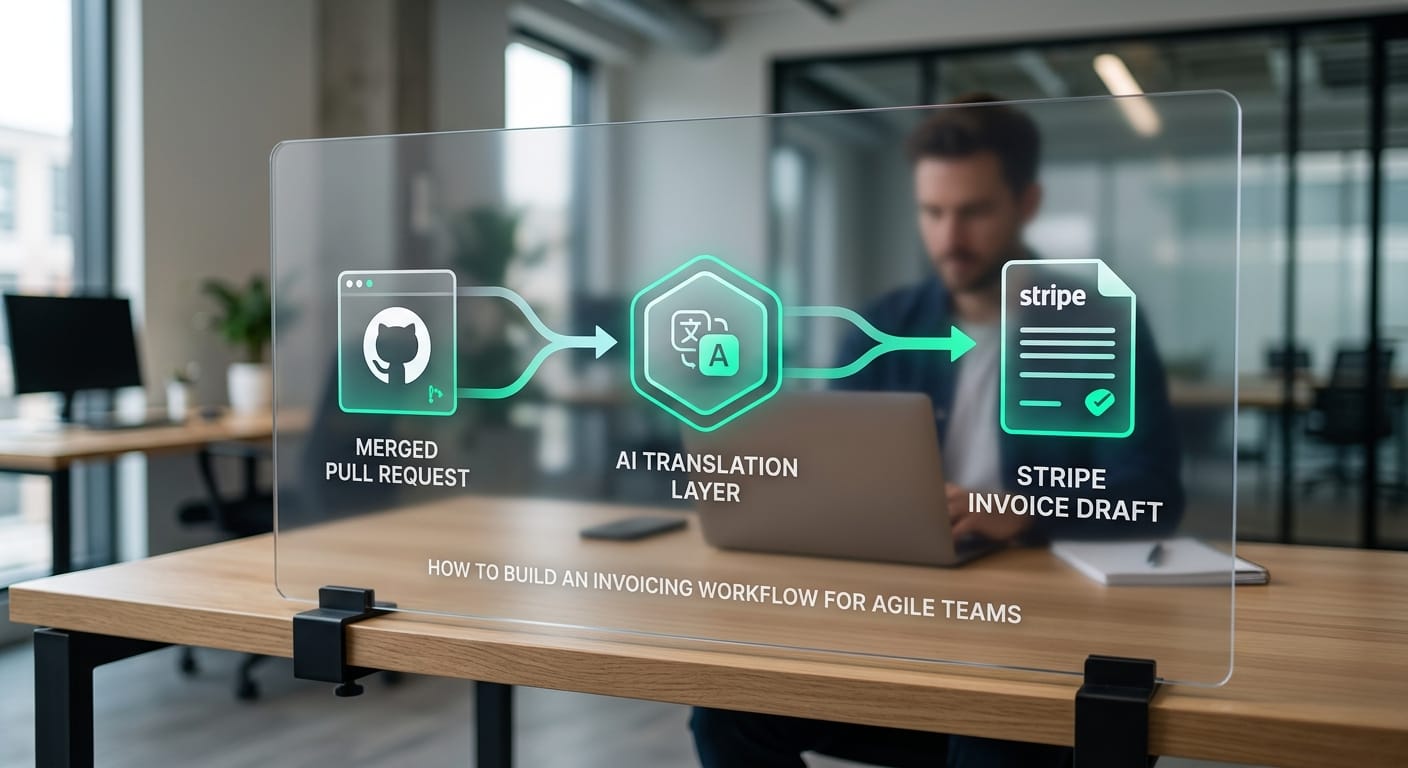
The Three Layers of Automation
Breaking down the invoicing lifecycle helps you identify bottlenecks and choose the right automation tools for your tech stack.
- Ingestion (The Trigger): Your billing system needs a clear entry point to start capturing data. For agile developers, a merged pull request acts as the perfect trigger to verify that code has been completed and safely shipped.
- Extraction and Translation: Raw code commits are rarely appropriate for a client's accounts payable department. This middle layer utilizes AI to capture technical data rapidly and translate developer jargon into clear, client-ready line items (Source 3).
- Export to Finance: The finalized, client-ready data is immediately pushed to your payment gateway or Accounting software. Creating real-time integration with a billing platform establishes a single source of truth for your financial data (Source 3).
Connecting these layers allows you to support the flexible, usage-based billing models your modern clients expect. Unifying the developer workflow with the billing export helps you scale your consulting operations seamlessly without needing to grow your administrative headcount (Source 1).
Step-by-Step: Automating Invoicing from GitHub to Stripe
You do not need a massive, six-month ERP implementation to scale your agency's billing operations. By connecting the repository your developers already use, you can automate developer invoices and build an automated invoicing workflow for agile development teams. This pipeline uses merged code as a reliable trigger to eliminate manual data entry entirely.
Replacing manual billing with an automated sequence requires three basic layers: a trigger, a processing step, and an export destination, according to Source 5. Instead of copying and pasting updates into spreadsheets at the end of every sprint, you can connect your source control directly to your billing software. This kind of integration allows your invoicing to scale smoothly without forcing you to grow your administrative headcount, an advantage noted by Source 1.
How to connect your tech stack
Connect your repositories
Translate technical jargon
Export and bill
Bridging the gap between engineering output and finance keeps your entire team focused on shipping top-tier software. For growing agencies, this structured workflow ensures no billable deliverables slip through the cracks between a deployment and the final billing cycle. By leveraging a scalable setup like the diffbill Team plan, you secure the higher request limits and CSV client export functions necessary to juggle multiple active projects at once.
Start billing
Frequently Asked Questions About Agile Billing
Adopting an invoicing workflow for agile development teams often raises questions about client communication, data privacy, and managing countless small tasks. A robust system solves these concerns by transforming granular technical work into transparent, source-linked audit trails so clients instantly understand the value they receive.
Security is usually the top priority when connecting code repositories to financial software. Modern cloud-based billing platforms handle this using strict authentication features and end-to-end encryption, according to Source 4. This setup keeps your sensitive project details safe without requiring developers to manually censor their commit history.
Navigating Common Billing Hangups
Development teams also worry about the friction of adopting new administrative routines. Migrating away from legacy systems to a highly automated agile invoicing workflow often brings messy integrations and internal resistance, as noted by Source 1. You can bypass these roadblocks by choosing tools that automatically ingest data directly from the platforms your team already uses every day.