
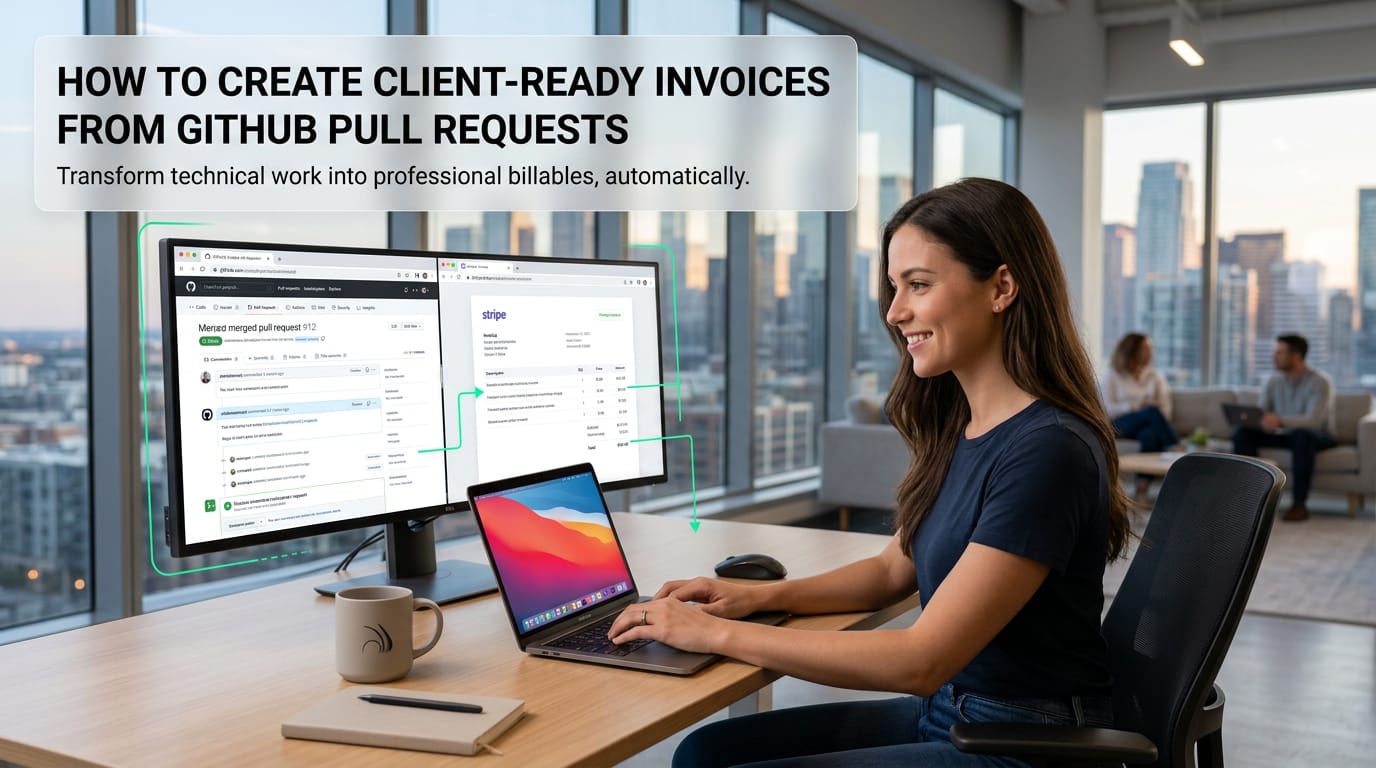
How to Create Client-Ready Invoices from GitHub Pull Requests
A complete guide for freelance developers and consultants to automate client-ready invoicing directly from GitHub pull requests using AI.
Stop wasting unbillable hours translating technical commits into business jargon. Learn how to convert a PR to an invoice by transforming your merged GitHub pull requests directly into professional, client-ready Stripe drafts.
The Hidden Cost of Translating Code into Invoices
Every time you sit down to create client ready invoices from GitHub, the manual translation process quietly eats into your schedule. You aren't just copying and pasting; you are translating deeply technical commits into business-facing updates that clients actually understand. This constant context-switching pulls you away from high-value development work.
The Monthly Translation Tax
Translating a month's worth of pull requests relies heavily on memory and digging through old code. Instead of simply billing for your shipped features, you are forced to retrace your own steps:
- Parsing through messy commit histories and merged pull requests to remember what actually shipped.
- Recalling the specific business value behind a refactored API endpoint or a complex database migration weeks after the fact.
- Scrubbing out internal developer jargon to write professional, clear line items.
All this digging and rewriting adds up faster than you might think. On average, you lose about five minutes of formatting and translation time for every single pull request you process manually. For an active freelance developer or consultant, that quickly snowballs into hours of lost revenue every single billing cycle.
Sticking to this manual workflow means you are essentially working for free just to get paid. By relying on the status quo of copying, pasting, and rewriting, you sacrifice your focus and let administrative overhead cut directly into your profit margins.
Why Native Tracking Tools Don't Build Client-Ready Invoices
When you try to create client ready invoices from github using default tracking tools, you quickly run into a translation problem. Raw commit logs and issue trackers are built to help developers write software, not to help billing departments understand return on investment. Sending a client a list of granular commits forces them to decode your technical workflow into terms their accounting team can actually approve.
Why raw commit histories delay your payments
Relying on out-of-the-box repository histories creates immediate friction at the end of the billing cycle. Your stakeholders are paying for outcomes, but raw project logs focus heavily on the journey. This communication mismatch usually leads to a few predictable roadblocks:
- Exposing technical debt: Commits detailing refactored legacy code or fixed memory leaks often prompt clients to question why the code was broken in the first place.
- Irrelevant granularity: Showing dozens of minor micro-commits confuses stakeholders who just want a high-level summary of the features you delivered.
- Internal jargon: Routine maintenance notes about updated build packs or bumped dependencies mean nothing to non-technical managers and trigger unnecessary email threads.
Every minute you spend explaining technical line items is an unbillable constraint on your business. Bridging this communication gap is the only way to consistently create client ready invoices from github without writing everything from scratch. You need an automated process that shifts the focus away from the code you pushed and highlights the actual problems you solved.
How to Map GitHub PRs to Stripe Invoice Drafts
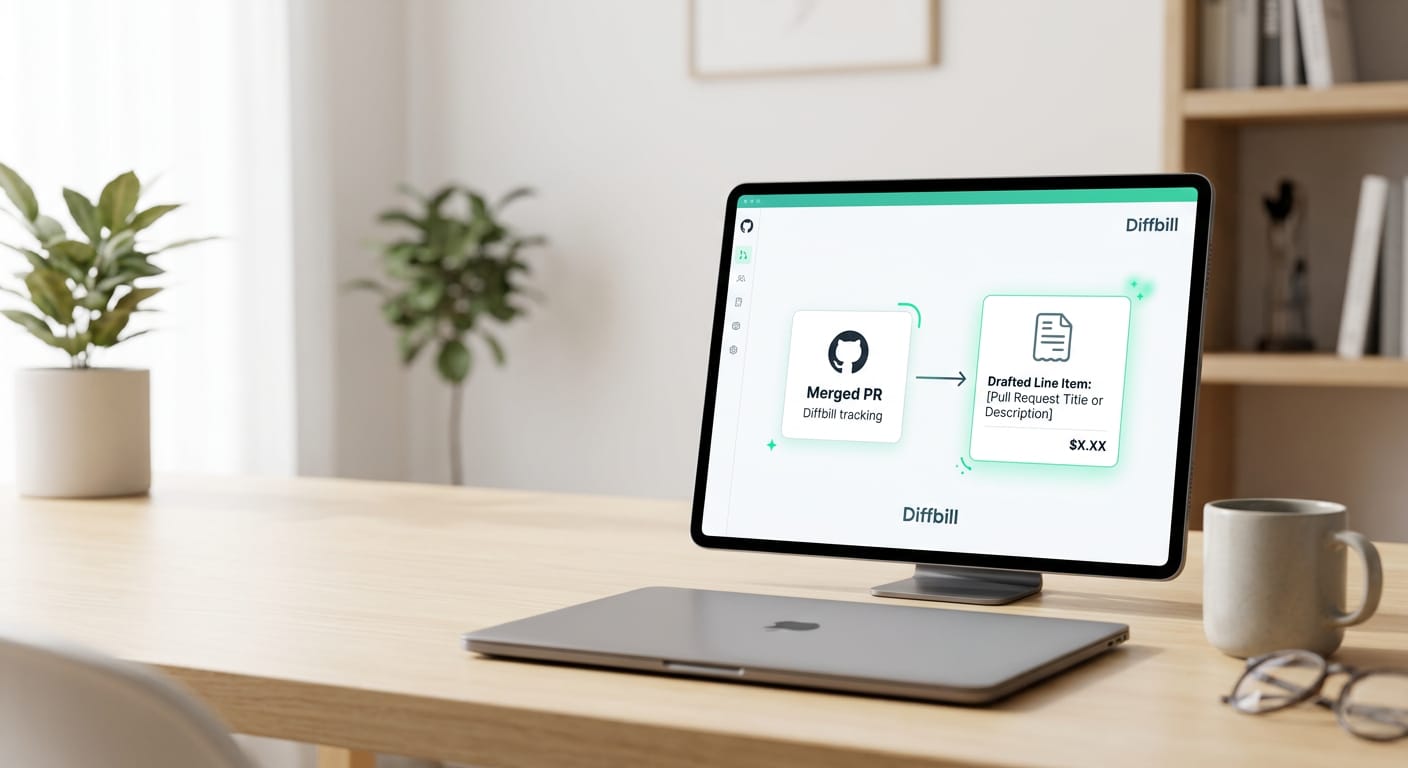
Connecting your repository directly to your billing system eliminates manual data entry and provides a source-linked audit trail for complete transparency. When you want to create client ready invoices from github, the most efficient route is mapping merged pull requests directly to Stripe. Instead of copying commit histories at the end of the month, your workflow triggers the exact moment your code ships.
Leaving technical details raw on a billing statement often confuses stakeholders and delays your payment. By routing merged PRs into a drafted, editable state, you maintain absolute control over the final narrative. Diffbill sits in the middle, intercepting the merge event to translate internal code jargon into clear business value.
Translating Code Drops into Billing Drafts
Merging the PR in GitHub
AI reviewing and redacting technical details
Pushing the drafted line item to Stripe
Once this automated pipeline is running, the friction of end-of-month billing ops and administrative work disappears. You keep a seamless, keyboard-first workflow while the platform stages your actual billing data in the background automatically.
A mapped workflow gives you a few immediate business advantages:
- Source-linked proof: Every line item points back to a specific PR, giving clients certainty about what they are funding.
- Editable staging: Items land as drafts, letting you adjust pricing or finalize formatting before hitting send.
- Focused execution: Setting up this direct sync helps you avoid underbilling on small fixes and is the smartest way to create client ready invoices from github while keeping your attention entirely on the codebase.
Rewriting Technical Jargon into Business Value
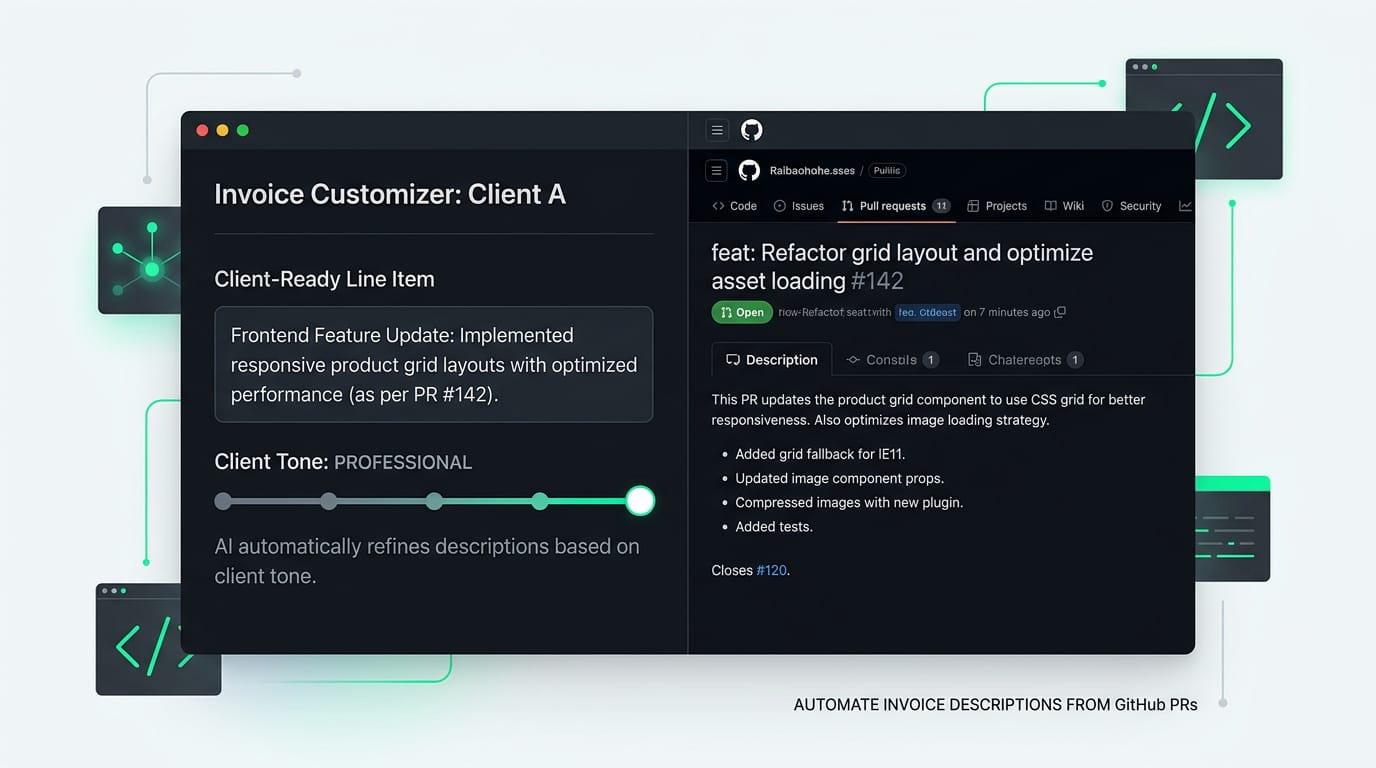
To efficiently create client ready invoices from github, you need to stop manually translating your commits at the end of the month. Instead of sending clients a confusing list of refactored hooks and database migrations, an AI-powered rewriting layer can automatically frame your work around its business value. This ensures your clients appreciate exactly what was delivered without getting lost in the technical weeds.
If you want to sanity-check that translation on one real example, try the PR to invoice line item generator with a recent merged pull request.
Every client communicates differently, which is why customizable tone and verbosity controls are crucial. A startup might prefer concise, punchy bullet points, while an enterprise stakeholder might expect detailed, formal summaries of the new features. You can seamlessly tailor the output for each client, automatically stripping out sensitive internal repository tags, issue numbers, and developer shorthand before the invoice is ever drafted.
Bridging the Translation Gap
Translating pull requests to go from a merged PR to client-ready line items isn't just about sounding professional; it's about minimizing friction during billing. When line items emphasize user outcomes—like faster checkouts or secure logins—clients approve invoices faster and ask fewer questions.
Automating this translation step to create client ready invoices from github removes the single biggest bottleneck in freelance billing. By letting intelligent automation handle the draft, you guarantee a few structural benefits:
- Consistent professionalism: Every line item matches your personal brand and the varying expectations of your clients.
- Fewer billing disputes: Clear, value-driven descriptions prevent clients from challenging technical tasks they don't fully understand.
- More billable hours: You reclaim the tedious administrative time spent digging through weeks of code history just to remember what you built.
Start Automating Your GitHub Invoicing Workflow
Ready to stop bridging the gap between your codebase and your accounting tools by hand? Every hour you spend translating technical commits into business language is an unbillable hour lost to administration. Instead of wrestling with spreadsheets or building custom integrations, you can now create client ready invoices from github automatically.
Adopting effective developer invoicing automation strategies to set up a streamlined workflow directly syncs your shipped code to Stripe. Your billing routine becomes a seamless extension of your development lifecycle:
- Pull merged PRs directly into your draft billing queue.
- Rely on AI to rewrite heavily technical commit messages into clear, professional line items.
- Push the formatted drafts straight to Stripe without any repetitive data entry.
Automate Your First Repository
The easiest way to test this process is on a live, active project. The free Starter Plan provides a simple entry point to automate client invoicing from GitHub activity for your first repository without any upfront commitment. It handles the initial AI rewriting and applies default redactions automatically, ensuring your proprietary code details stay secure while testing the workflow.
Experience the relief of letting your shipped code do the administrative heavy lifting. Set up your basic single-repo automation today and turn your next merged pull request directly into a professional Stripe draft.
Continue with Free