
Lightweight Invoicing Tools for Minimalists: Cut Features, Not Profit
Compare top lightweight invoicing tools that ditch CRM bloat in favor of speed, privacy, and minimalist billing workflows for freelancers.
Discover the best lightweight invoicing tools that strip away CRM bloat, focusing on speed, privacy, and seamless workflows for freelancers and developers.
What makes an invoicing tool truly minimalist?
The most effective lightweight invoicing tools for minimalists strip away aggressive tracking, mandatory client portals, and bloated customer relationship management (CRM) features. Instead, they focus exactly on what matters: helping you generate accurate bills quickly and get paid without locking your workflow behind complicated dashboards.
Key Takeaways
- Focuses strictly on invoice generation instead of full client management.
- Avoids mandatory accounts and logins for your clients.
- Prioritizes fast execution and respects data privacy.
Ditching the bloat for speed and privacy
Traditional billing platforms often act more like enterprise software than simple payment utilities. As noted by Source 3, bulky software and overly complex spreadsheets turn a simple administrative task into a time-sucking headache. Minimalist tools bypass this entirely by prioritizing frictionless data entry and clean outputs. They typically share a few core traits:
- No mandatory client logins: Clients review and pay directly via secure public links without needing their own accounts, which Source 2 notes is critical for reducing payment friction.
- Lightweight delivery formats: Invoices are delivered as clean PDF exports or native Stripe drafts rather than requiring users to log into a third-party ecosystem.
- Strict data privacy: Your financial data and client details remain secure, without being harvested for future software upselling.
A truly streamlined workflow respects your client's time just as much as your own. When comparing lightweight invoicing tools for minimalists, look for platforms that keep you out of the formatting weeds. You retain full control over your daily billing cycle without the frustrating overhead of managing a massive, bloated database just to send a single bill.
The hidden costs of traditional billing software
Traditional billing applications force you to navigate complex enterprise dashboards just to send out a simple bill. Instead of paying for bloated CRM features you will never use, finding the right lightweight invoicing tools for minimalists eliminates this administrative friction. You save money and reclaim billable hours by skipping mandatory subscriptions and cluttered interfaces.
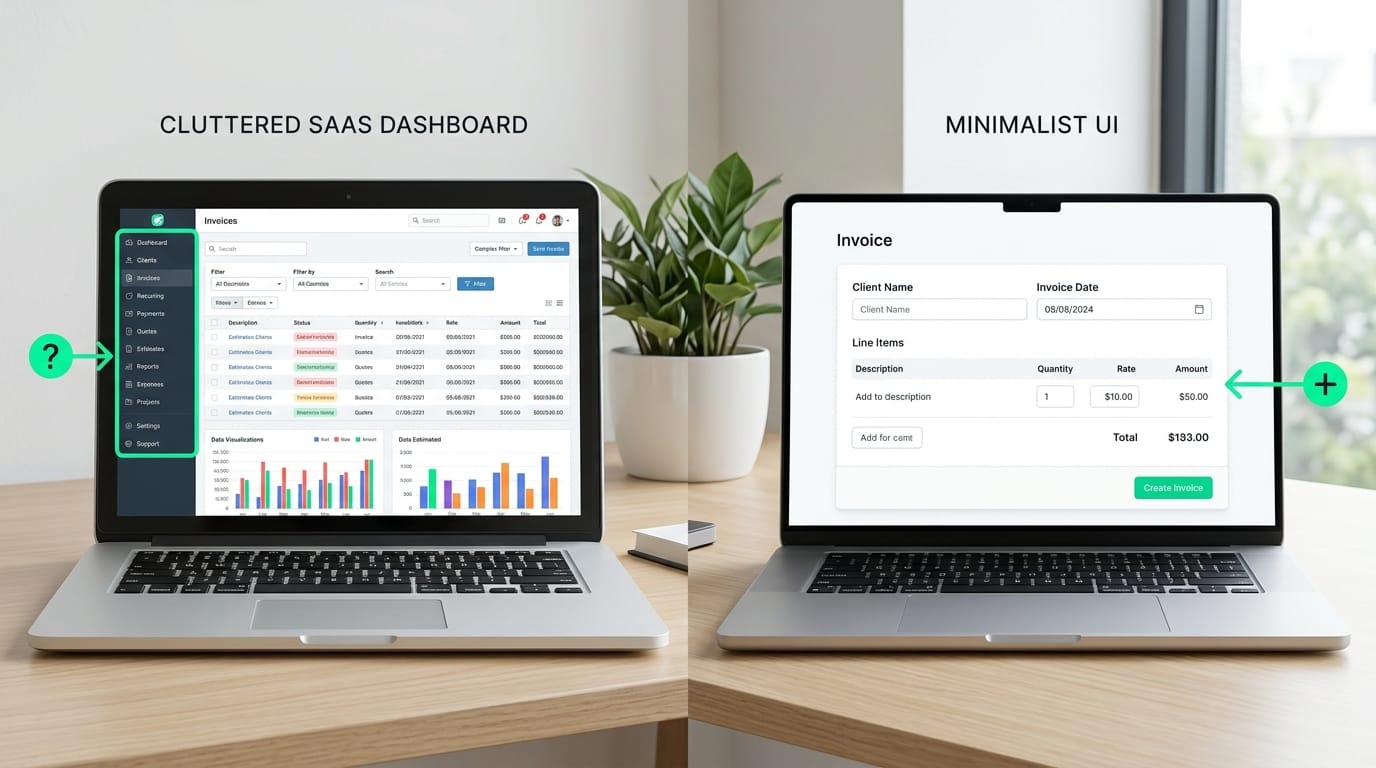
Mainstream platforms often demand too much effort when you only need to send a handful of invoices per month (Source 3). You sign up expecting a fast workflow, but are immediately hit with subscription upgrade prompts and features designed for corporate accounting departments. This constant friction turns a simple two-minute administrative task into a frustrating, multi-step ordeal.
The heavy price of traditional tools
Beyond the direct financial squeeze of monthly SaaS fees, heavy invoicing platforms often trap your client records in proprietary data silos (Source 2). The tradeoff for using these expansive systems is handing over excessive personal and banking details just to generate a basic PDF (Source 3). A dedicated lightweight invoicing tool for minimalists avoids this privacy risk entirely by keeping the focus strictly on your line items and pricing.
When you evaluate traditional software against streamlined alternatives, the hidden costs usually fall into three categories:
- Feature overload: You waste time clicking through marketing hubs, inventory trackers, and reporting widgets just to find a blank invoice template.
- Data lock-in: You give up control over your client billing history in exchange for a proprietary platform that makes bulk exporting difficult (Source 2).
- Subscription traps: You hit arbitrary limits on the number of clients you can bill or documents you can save unless you upgrade to a premium tier (Source 3).
Comparing the best lightweight invoicing tools
Finding the best lightweight invoicing tools for minimalists comes down to how much infrastructure you want to manage. Whether you are building from scratch or doing a developer invoicing software comparison, your exact fit will range from simple, no-login web generators for occasional projects to self-hosted applications that keep your data entirely private. Evaluating these options means prioritizing speed and low administrative overhead over bloated feature sets.
No-login web generators
If you only send a few bills a month, traditional document templates often cause more friction than they solve. Instead of wrestling with spreadsheet formulas or breaking document layouts (Source 1), modern free invoice management tools for contractors often function as no-sign-up web generators that offer a much faster route. These browser-based tools let you input your line items and download a clean PDF immediately. You skip the account creation process entirely and avoid handing over personal data simply to track your payments (Source 3).
Self-hosted billing applications
For developers and freelance professionals handling higher project volumes, self-hosted applications provide full control without the monthly subscription fees. These applications run exclusively on your own infrastructure, ensuring client data never sits on a third-party server. When evaluating server-based tools, you generally have two distinct approaches to choose from:
- Hyper-minimalist stacks: Tools like Invio strip away everything but the essentials. Built on lightweight tech like SQLite, they let you issue secure, password-free invoice links straight to your clients without requiring any portal logins (Source 2).
- Full-circle billing: Applications like InvoicePlane offer slightly more structure for growing freelancers. They manage the entire flow from initial project quotes to customized digital invoices, while still integrating directly with payment gateways like Stripe (Source 4).
Ultimately, the most effective lightweight invoicing tools for minimalists remove manual bottlenecks so you can focus on shipping your actual work. By ditching bloated CRM platforms, you regain control over your billing process, your profit margins, and your privacy.
How developers can skip data entry completely
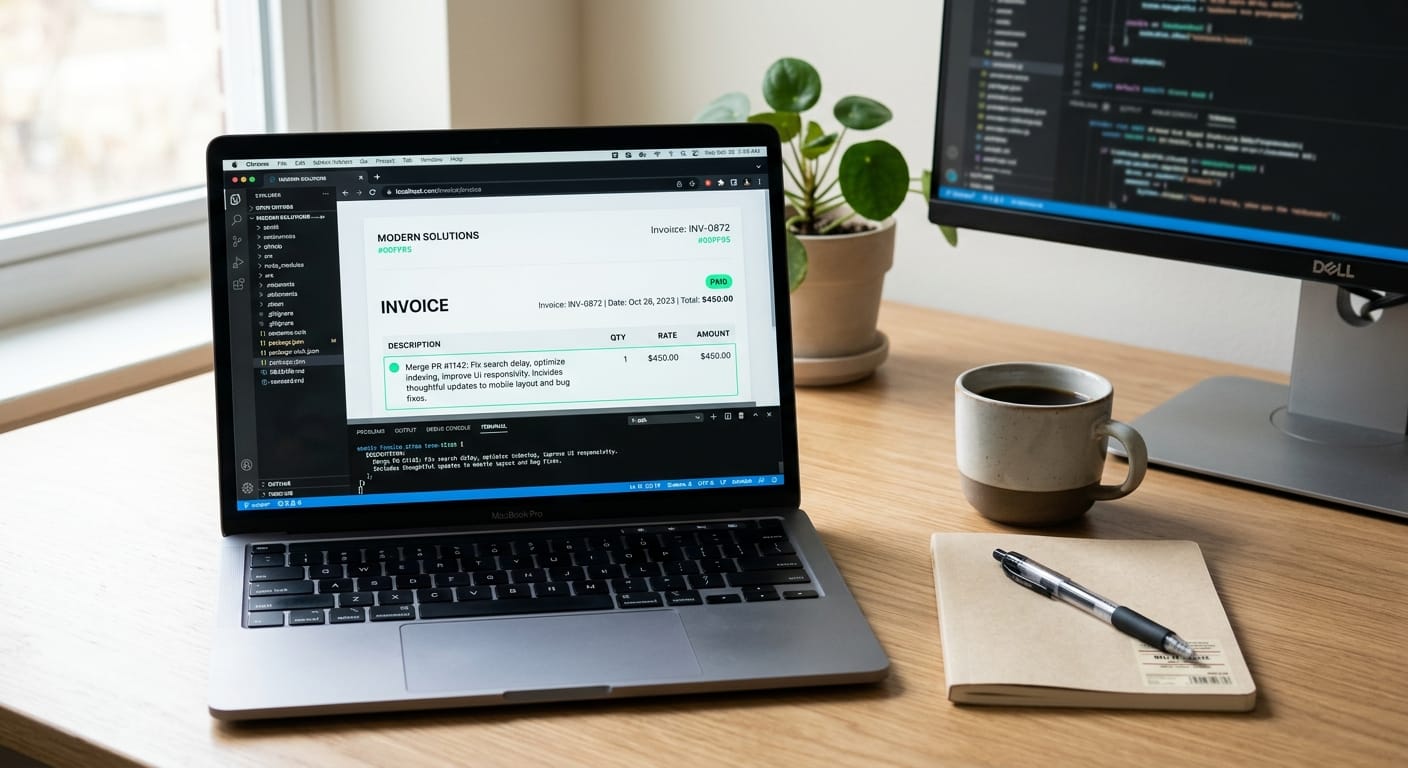
The ultimate setup for developers removes manual billing entirely by generating invoices directly from shipped code. While many lightweight invoicing tools for minimalists focus on simpler interfaces, the most efficient approach is to convert a PR to an invoice. This completely automates the workflow by translating your merged GitHub pull requests straight into Stripe drafts. This drops invoice creation time to zero.
Traditional billing systems often become a recurring time sink that introduces administrative friction and delays payments, as highlighted by Source 1. Even self-hosted apps designed to avoid enterprise CRM clutter still force you to type out line items manually (Source 2). This means you end up documenting the work twice: once in your code editor and again in your accounting software.
Automating the GitHub to Stripe pipeline
When figuring out how to automate invoicing from a GitHub repo, you can eliminate this redundant data entry by letting AI handle the translation step. Instead of copy-pasting commit hashes and backend jargon, your invoicing workflow can automatically rewrite your repository activity into professional, client-facing language. This seamless handoff ensures you capture every billable update without ever opening a spreadsheet.
Ship code
AI analyzes work
Review in Stripe
Automating your line items protects your focus hours while maintaining absolute billing transparency with your clients.
- Eliminates missed billables: You easily avoid underbilling on small fixes and underlying infrastructure tweaks because everything is captured.
- Maintains professional polish: Clients receive a clear summary of the business value delivered, rather than cryptic technical commits.
- Accelerates cash flow: Drafts are ready the moment the pull request is merged, meaning you can hit send immediately.
Continue with Free
Frequently asked questions about minimalist invoicing
Stripping away software bloat does not mean you have to sacrifice professionalism or payment speed. In fact, lightweight invoicing tools for minimalists focus purely on secure, efficient billing by removing complex CRM features. This ensures you maintain full control over your payment pipeline without paying for dashboards you never use.
Developers often worry about handing sensitive client financial data over to heavy SaaS platforms. According to Source 2, self-hosted applications solve this by keeping all database records on your own infrastructure to prevent data leaks or vendor lock-in. Meanwhile, no-sign-up generators let you issue a quick bill without trading away personal information, avoiding the upsell pop-ups found in traditional software (Source 3).
A reduced feature set still needs to meet strict modern business requirements. Open-source billing platforms easily handle standard compliance, including the creation of regulated eInvoices required by the European Union (Source 4). Moving to a streamlined, purpose-built tool also prevents the minor formatting and calculation errors that frequently delay payments when relying on static office documents (Source 1).