
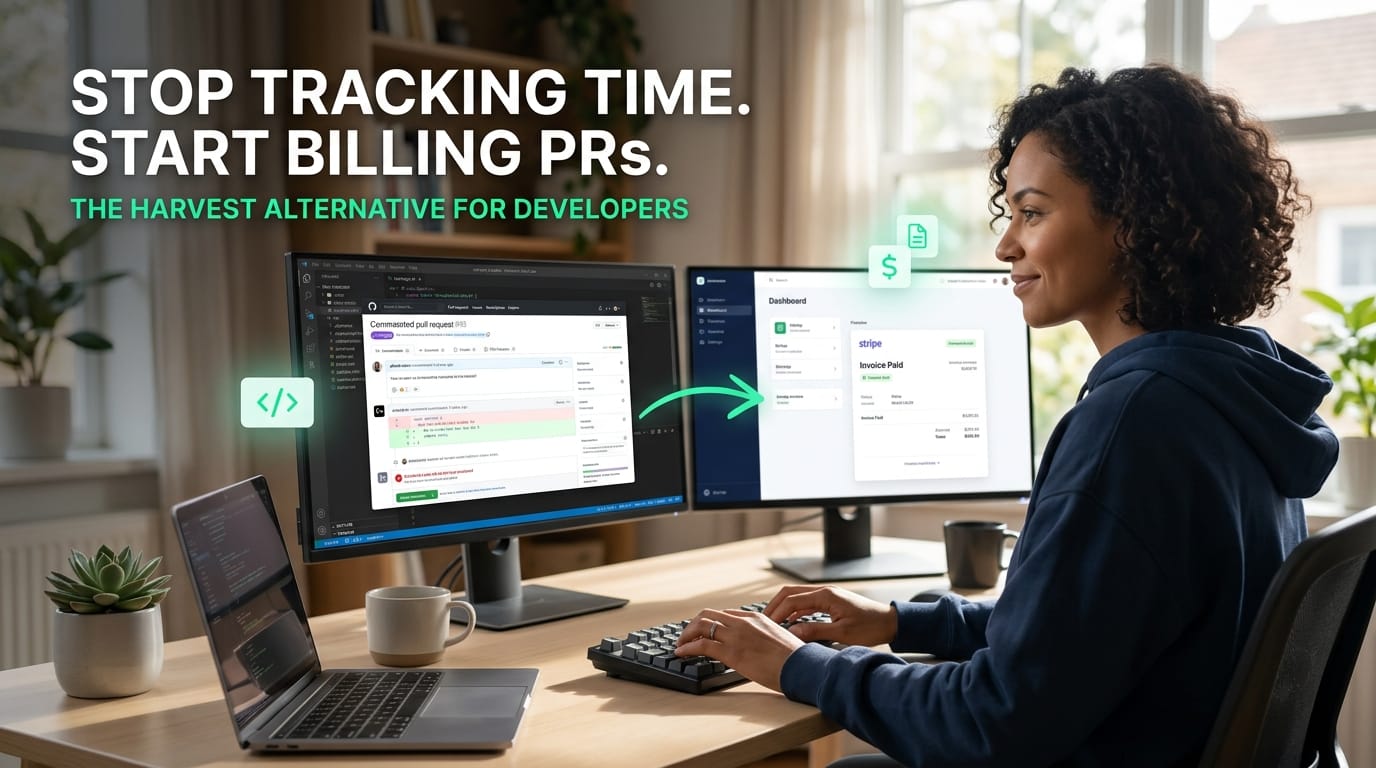
The Best Harvest Alternative for Developers: Stop Tracking Time, Start Billing PRs
Looking for a Harvest alternative for developers? Compare top options and learn how to automate your billing pipeline directly from GitHub PRs without tracking hours.
Developers hate manual time tracking. Discover why the best alternative to Harvest isn't another stopwatch app, but a workflow that turns your GitHub pull requests directly into paid Stripe invoices.
Why developers are dropping Harvest's manual timers
The best harvest alternative for developers isn't another stopwatch app, but a shift away from manual time tracking entirely. Developers are dropping Harvest because relentless context switching destroys deep work. Managing timers constantly pulls your focus away from complex problem-solving and writing quality code.
Traditional time tracking forces you to operate like a human punch clock. Every time you pause to review a pull request or answer a team message, you have to toggle a timer. This administrative friction fragments your attention and breaks the flow state required for meaningful software development.
The hidden costs of the time-tracking status quo
Sticking with Harvest or similar legacy trackers often leaves freelancers eating the cost of their own administrative time. When you inevitably forget to log a quick bug fix or a brief client consultation, that work goes completely unbilled.
- Lost billable minutes: Guessing how long a task took after the fact almost always results in underestimating your effort.
- End-of-month panic: Reconstructing your week from Git commit histories to fill out a blank timesheet takes hours of unpaid busywork.
- Client friction: Sharing highly granular time logs often invites non-technical clients to micromanage how long specific coding tasks should actually take.
Moving to a modern harvest alternative for developers means valuing the features you ship over the minutes you sit at a desk. By transitioning away from hourly billing and toward a workflow based on tangible output, you eliminate the stopwatch entirely. This approach lets you focus fully on the codebase while ensuring every completed feature makes it onto the final invoice.
Time tracking vs. Output-based billing
The standard approach to freelance engineering relies on legacy software to simply count minutes. But the most effective Harvest alternative for developers isn't a better stopwatch—it is a complete shift to output-based billing. Instead of tracking hours, modern consultants bill directly for merged pull requests and shipped features.
Traditional time tracking forces you to micromanage your workflow. When you evaluate standard Harvest alternatives like TimeCamp, Toggl, or Hubstaff (Source 1, Source 4), the underlying administrative process remains exactly the same. You still have to remember to toggle timers for every minor context switch or hotfix. This constant clock-watching breaks your programming flow state and turns Friday afternoons into a tedious timesheet reconstruction exercise.
The cognitive ease of shipping over tracking
Transitioning to an output-based workflow permanently uncouples your income from the clock. By exchanging hourly rates for PR-based pricing, you align your financial incentives with the client's actual goals. Your clients pay for working software in their repository, not the minutes you spent waiting for CI/CD pipelines to finish.
- Focus on deep work: You can solve complex bugs faster without feeling like your efficiency is actively cutting into your own paycheck.
- Zero timesheet anxiety: You bypass the mental friction of justifying a three-hour blocking issue or a long debugging session.
- Transparent deliverables: Clients easily approve invoices tied to specific GitHub pull requests rather than vaguely labeled blocks of hourly time.
Best general time-tracking alternatives to Harvest
Some client contracts strictly require traditional hourly spreadsheets and manual stopwatch tracking. If you are stuck with these billing constraints, the best harvest alternative for developers is usually Toggl Track, Clockify, or Hubstaff. These tools successfully replicate Harvest's core timesheet mechanics while offering different pricing models and lighter interface designs.
Key Takeaways
- Toggl Track is lighter than Harvest and works well for simple start/stop mechanics.
- Clockify offers a generous free tier for solo freelancers unwilling to pay Harvest's per-seat prices.
Comparing top timer-based replacements
If you just need a better digital stopwatch, the market offers several mature options. Each tool takes a slightly different approach to logging your coding hours and generating reports:
- Toggl Track: Frequently cited alongside Harvest, Toggl strips away bloated project management features in favor of a fast, keyboard-friendly interface. It is ideal if you just want to launch a timer, write code, and stop it without navigating through clunky dropdown menus.
- Clockify: As noted in industry roundups (Source 1), Clockify's primary advantage is a robust free tier that supports unlimited time tracking. It is a highly practical choice for independent developers who want to avoid Harvest's monthly subscription fees while still generating clean, exportable timesheets.
- Hubstaff: Reviewers on software comparison sites like G2 (Source 4) frequently rank Hubstaff as the top overall competitor to Harvest. However, it leans heavily into employee monitoring features like idle-time detection and periodic screenshots. While this satisfies strict corporate clients, most engineers find invasive tracking incredibly frustrating.
While these productivity apps solve Harvest's outdated interface logic, they still force you to constantly context-switch throughout the day. You are merely trading one manual timer for another, leaving the tedious admin work of translating commits into billable hours completely unresolved.
Diffbill: The Harvest alternative for GitHub workflows
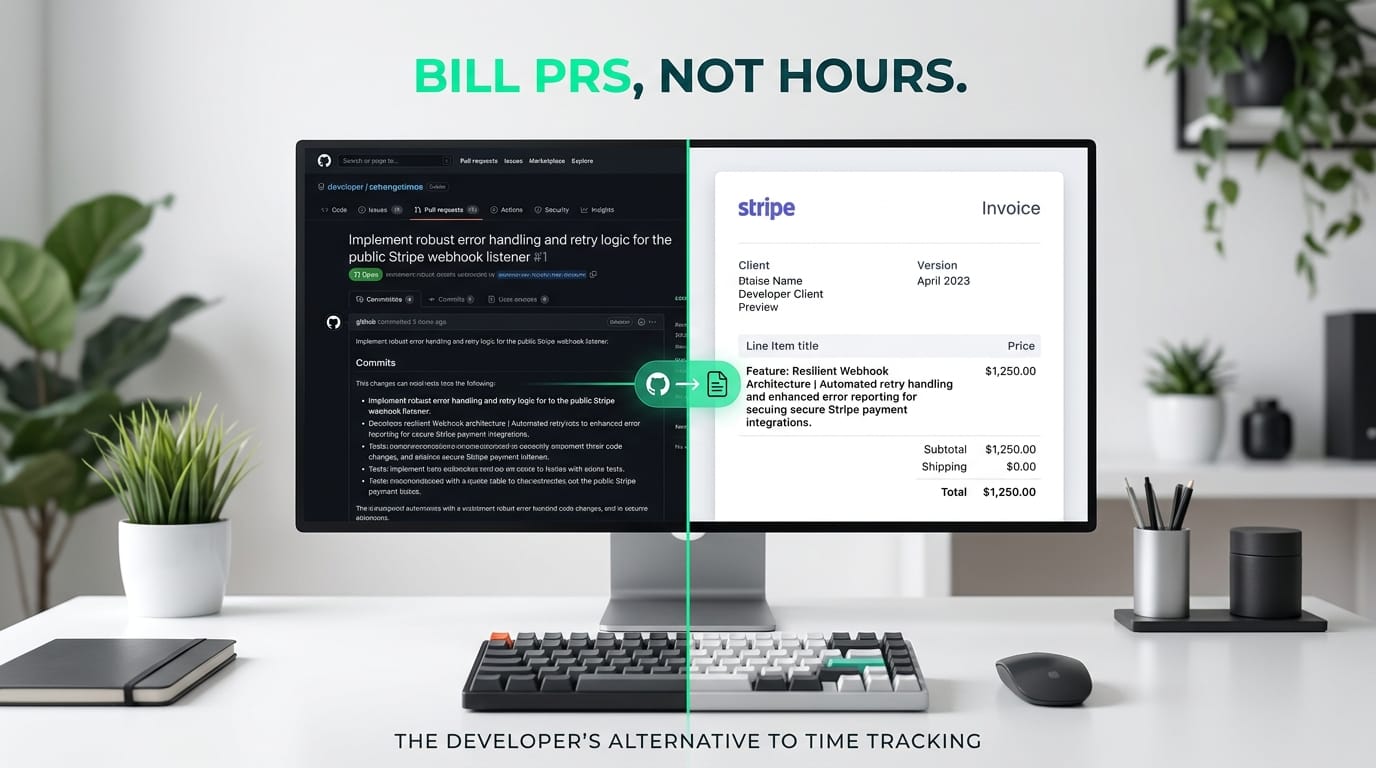
The best harvest alternative for developers abandons the stopwatch entirely and bills clients based on the code you actually ship. Instead of logging hours in a timesheet, tools like Diffbill automatically turn your merged GitHub pull requests into professional, client-ready Stripe invoice drafts.
When checking industry reviews for traditional time trackers, you will consistently find platforms like TimeCamp, Hubstaff, and Toggl Track functioning as direct equivalents. Unfortunately, these simply give you a different interface for the exact same manual task. You still have to remember to start a timer, pause it for context switching, and categorize your minutes manually.
Automate your billing from GitHub to Stripe
Diffbill flips the traditional billing model by syncing directly with your codebase repository. When you merge a pull request, the platform's AI evaluates your commits and reviews your highly technical Git jargon. It then seamlessly translates that codebase context into polished, easy-to-understand business formatting that non-technical clients appreciate.
This automated workflow eliminates the need for manual timesheets entirely. Freelancers looking for a powerful harvest alternative for developers gain advanced control over how their work is presented without spending hours writing administrative summaries. With Diffbill's Pro Plan, you can customize the final generated invoice output to fit your exact business needs:
- Per-client tone controls: Adjust the terminology so technical clients get granular system details while business stakeholders get high-level outcome summaries.
- Source-linked audit trails: Attach clear, verifiable proof of work directly to your invoice line items to build instant trust.
- Keyboard-first workflow: Review, edit, and push your drafted Stripe invoices to completion without ever taking your hands off the keyboard.
Stop penalizing yourself for solving complex engineering problems quickly. Reclaim your unbilled administrative hours and transform your daily engineering workflow directly into an automated revenue engine.
Start billing
Frequently asked questions about switching from Harvest
When evaluating a harvest alternative for developers, the biggest hurdle is rarely learning a new interface. The real challenge is changing how you talk to clients about money. Moving away from traditional timer apps like Hubstaff or Toggl Track (Source 4) means ditching hourly inputs and starting to bill for the actual code you ship.
You also do not need to port years of legacy timesheet data into a new system to make this switch. Most productivity platforms support standard data exports if you need historical records for compliance (Source 2). A fresh-start workflow tied directly to your codebase allows you to close your final Harvest invoice and immediately begin billing your next sprint via pull requests.
Navigating the transition with clients
Moving clients to output-based invoicing works best when you emphasize transparency and predictable delivery. Instead of sending a complicated dashboard of tracked minutes from a traditional tool like TimeCamp (Source 1), you present an explicit, source-linked list of merged features. This approach eliminates awkward conversations about why a specific bug fix took three hours and focuses the business relationship on the exact value delivered.
Here are the most common questions freelancers and consultants have when trading in their stopwatch for a source-linked invoicing workflow.