

Essential Tax Compliance Features to Look for in Global Billing Software
Learn which tax compliance features matter most in global billing software, including real-time nexus tracking, VAT support, and automated calculation integration.
Discover the core tax compliance features global billing software must have to prevent audits and save time, from automated nexus tracking to seamless integration with developer workflows.
What makes global tax compliance software essential?
Global tax compliance software automates the entire tax lifecycle, instantly calculating jurisdiction-specific rates, tracking legal nexus thresholds, and preparing filings across borders.
Evaluating the right tax compliance features in global billing software ensures you collect the exact amount of tax required without building a custom invoicing engine. Modern platforms analyze every transaction in real time to determine taxability, instantly applying the correct sales tax, VAT, or GST before a payment is ever processed.
Why manual compliance falls short
Relying on spreadsheets to manage cross-border obligations is incredibly risky. The United States alone has over 14,000 distinct taxing jurisdictions with constantly changing tax rates (Source 1). If your invoicing logic relies on static database tables and manual spreadsheet calculations, you expose your business to compounding data errors, outdated rules, and expensive audit liabilities.
Instead of hardcoding tax logic that breaks when governments introduce new regional digital service taxes, specialized tax platforms tackle the complexity for you. The most essential tax compliance features in global billing software generally automate three core pillars:
- Real-time tax calculation: Determines the exact tax owed based on the buyer's location, IP address, and product category, instantly covering hundreds of international regions.
- Economic nexus monitoring: Actively tracks your transaction count and sales volume in specific jurisdictions, alerting you the moment you cross the legal threshold to register.
- Automated reporting: Consolidates complex state, county, and country-level transaction data into clear records to simplify filing and ensure continuous audit readiness (Source 3).
Automated nexus tracking and real-time monitoring
Real-time multi-state and international tax monitoring is the difference between seamless scaling and surprise audit penalties. The most critical tax compliance features in global billing software automatically track your cross-border transaction volume. This automation empowers your team to shift from manual, defensive compliance directly into proactive value creation (Source 4).
At the core of this monitoring is the "economic nexus." This is the precise threshold of sales revenue or transaction volume that legally triggers a tax obligation in a new state or country. Relying on static spreadsheets to track these fluid limits across the US's more than 14,000 taxing jurisdictions is virtually impossible for a scaling software business (Source 1).
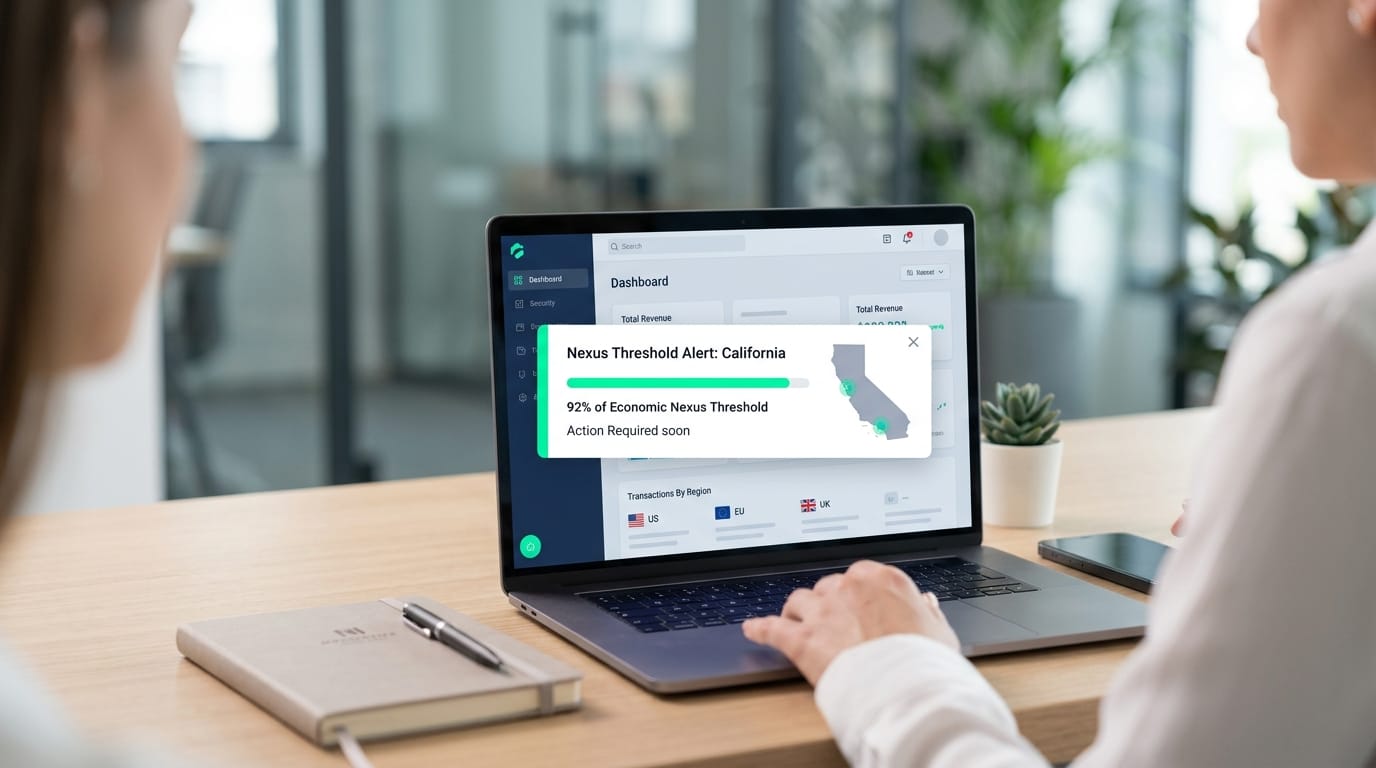
How background monitoring protects your revenue
Modern tax compliance software natively integrates with your digital infrastructure to prevent threshold breaches silently. Instead of manually exporting datasets to cross-reference against changing international laws, development and operations teams rely on real-time event triggers.
Proactive threshold alerts
Comprehensive global coverage
Automatic rule updates
Seamless data integration with billing and ERP systems
The most powerful tax compliance features in global billing software are useless if they operate in a silo. To actually prevent audits and save time, your compliance tools must integrate perfectly with the systems where your business collects revenue. Without direct data connections, agile development teams and finance departments are left bridging the gap manually.
When tax logic is disconnected from your core billing platform, teams are forced to rely on fragmented reporting processes. According to Source 4, manually exporting sales data to spreadsheets and cross-referencing global rates exposes organizations to inefficiency and heightened audit risk. Every disconnected data transfer creates another opportunity for costly human errors to impact your bottom line.
Preserving data integrity from checkout to filing
Robust API connections or native platform integrations ensure that tax determination happens programmatically at the exact moment of checkout. Natively built solutions, like Stripe Tax, integrate directly into your existing payment workflows to calculate obligations silently in the background (Source 5). This unified architecture ensures that every single transaction is automatically synced with the correct regional tax codes.
Connecting these tax compliance features directly into your revenue stream also guarantees a secure, immutable audit trail. Because the compliance engine is tightly coupled to your billing API, an exact historical log of what was calculated—and why—is permanently preserved alongside the invoice. You eliminate the exact data silos that trigger audits while completely removing manual compliance tasks from your team's workflow.
Comprehensive coverage for cross-border taxation (VAT and GST)
Expanding your business internationally introduces a maze of new regulations, making comprehensive cross-border coverage one of the most critical tax compliance features in global billing software. A capable system automatically monitors international thresholds, applies localized categorization rules, and calculates the correct Value-Added Tax (VAT) or Goods and Services Tax (GST) for every transaction.
Every country enforces its own unique tax framework. For example, European nations rely heavily on localized VAT regulations, while countries like India operate under complex GST structures with multiple tax slabs (Source 3). Manually tracking these shifting international laws drains development resources and leaves your business or solo dev shop vulnerable to non-compliance penalties.
Automating international thresholds and categorization
As your international sales grow, you risk crossing economic nexus thresholds in foreign jurisdictions without realizing it. The strongest billing platforms solve this by monitoring your global transaction volume in real time against local laws. Once you hit a specific country's threshold, the system automatically alerts you to register and begin collecting tax.
To safely navigate cross-border taxation without bloating your financial stack, evaluate potential software based on how deeply it automates international complexities. Your chosen solution should handle:
- Real-time rate updates: The platform should automatically pull live tax laws and rates across thousands of global jurisdictions (Source 1).
- Product taxability mapping: Because rules change depending on what you sell, the software must accurately match your specific services or software subscriptions to hundreds of local tax codes (Source 5).
- Cross-border compliance rules: Modern tools must account for emerging digital services taxes and complex withholding policies that target online businesses operating globally (Source 3).
Connecting your development workflow to tax-compliant billing
Developers should spend their time shipping code, not calculating VAT or monitoring nexus thresholds. By evaluating the tax compliance features in global billing software, you can learn how to automate developer invoices and fully bridge the gap between your daily technical work and final billing. This keeps you compliant without dragging down your creative momentum.
Managing local tax policies manually is a massive time sink for independent developers and consultants. Tracking state sales tax guidelines alongside international VAT variations usually requires exporting sales data into convoluted spreadsheets. Relying on these fragmented, manual processes directly exposes freelancers to inefficiency and heightened audit risks from tax authorities (Source 4).
Bridging code repositories with tax automation
Instead of jumping between tabs every billing cycle, you can leverage specialized workflow bridges to connect your code directly to a compliant billing engine. For instance, converting a PR to an invoice by pulling merged GitHub pull requests straight into a platform like Stripe naturally handles advanced tax management on your behalf. Built-in compliance tools monitor nexus thresholds, track rate changes, and calculate tax in real time across more than 100 countries (Source 5).
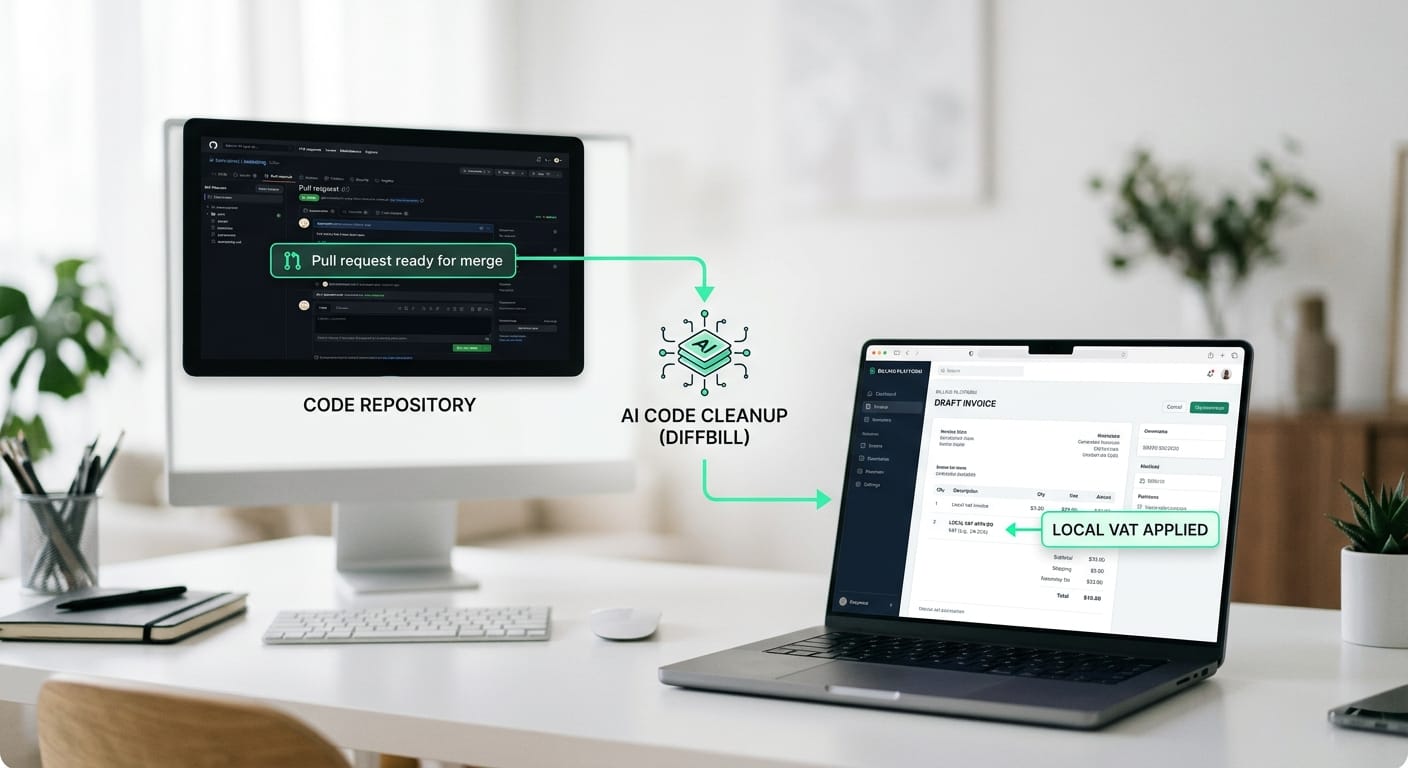
Automating your specific billing workflow protects your freelance business while eliminating repetitive administrative steps. You can build an efficient, keyboard-first process by:
- Pulling merged technical work directly from your GitHub repositories.
- Customizing your invoice tone so technical work is translated into polite, client-ready line items.
- Generating a source-linked invoice draft where the billing platform manages the final regional tax calculations.
Start billing